Shop at the MoonViews Store

LOIRP
- About
- Contact


RECOMMENDED BOOKS

Moonrush: Improving Life on Earth with the Moon's Resources

The Kaguya Lunar Atlas: The Moon in High Resolution

Lunar Reconnaissance Orbiter Mission

Lunar Orbiter Photographic Atlas of the Near Side of the Moon

The Far Side of the Moon: A Photographic Guide

The Clementine Atlas of the Moon

The International Atlas of Lunar Exploration

Voices from the Moon: Apollo Astronauts Describe Their Lunar Experiences

Apollo: Through the Eyes of the Astronauts

Main

Lunar Orbiter 1 ("I" or "A") Archives

August 23, 2011

First Earthrise Photo Taken 45 Years Ago Today

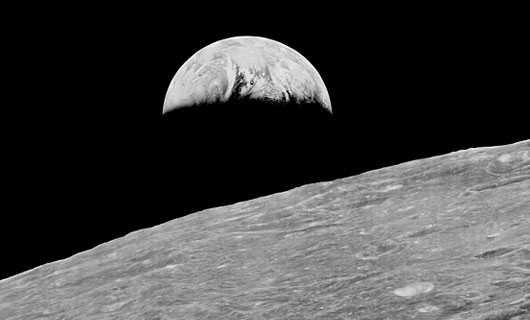
Keith's note: 45 Years ago today, on 23 August 1966, Lunar Orbiter 1 snapped the first photo of Earth as seen from lunar orbit (Larger view). While a remarkable image at the time, the full resolution of the image was never retrieved from the data stored from the mission. In 2008, this earthrise image was restored by the Lunar Orbiter Image Recovery Project at NASA Ames Research Center. We obtained the original data tapes from the mission (the last surviving set) and restored original FR-900 tape drives to operational condition using both 60s era parts and modern electronics. The following links provide background on the image, its restoration, and reactions to its release.

Here is a comparison of the full image in its original, familiar context (higher res)(print quality). You can download a 1.2 GB version from NASA here. Note: this is a very large file.

- Newly Restored Lunar Orbiter Image of Earth and Moon (Detail)
- How the Photo Was Taken
- House of Representatives Honors Lunar Orbiter Image Recovery Project
- Nimbus II and Lunar Orbiter 1 Imagery: A New Look at Earth in 1966
- Dumpster Diving for Science, Science Magazine
- What Lunar Orbiter 1 Was Seeing on 23 August 1966

June 3, 2011

Lee Scherer

Lee Scherer, KSC's 2nd leader, dies at 91, Florida Today

"Lee Scherer, who led Kennedy Space Center through its last major transition between human spaceflight programs, will be remembered in a service later this month near his home in San Diego, Calif. Scherer, KSC's second center director from 1975 to 1979, died May 7 at age 91. ... Joining NASA in 1962 on loan from the Navy, Scherer managed a program that launched five lunar orbiters mapping Apollo landing sites."

Keith's note: We were beyond thrilled to have Lee Scherer visit our Lunar Orbiter Image Recovery Project (LOIRP) operation at NASA Ames in November 2008 as we released the newly retrieved and restored "Earthrise" image taken by Lunar Orbiter 1 in 1966. As he walked into Building 596 (aka "McMoons" - it used to be a McDonalds) Lee was clearly stunned to see that we had found all of this old stuff and got it working again. We all had a tear in our eyes - it was like being in a Star Trek episode where something comes back from the past to a future where it simply should not exist.

At one point Lee told a story about some kids in his neighborhood who asked about an old picture he had hanging in his garage. Of course, it was the famous Earthrise image. You can imagine his reaction to seeing it presented in all its glory in a way not possible (technically) in 1966 - but in a way that now truly matched what one's mind's eye saw when this image first went viral in 1966. More than a generation later this image inspired the mission patch for STS-130 - the shuttle flight that carried a piece of the summit of Mt. Everest and four small Apollo 11 moon rocks that had been to the summit up to the International Space Station. The past meets the future once again.

Ad astra Lee.

(L to R) Greg Schmidt (NLSI), astronaut Yvonne Cagle, Lee Scherer, Lee's son, and LOIRP co-lead Dennis Wingo. Next to Lee Scherer are the original Lunar Orbiter tapes still backed in their archival containers.

(L to R) LOIRP co-lead Dennis Wingo, Lee Scherer, LOIRP engineer Ken Zin, and Nancy Evans. Ken ZIn is explainin gthe restoration process hwereby orignal FR-900 tape drives were brought back to life after 40 years.

(L to R) Lee Scherer, Nancy Evans, and Dennis Wingo stand in front of a restored FR-900 tape drive

Lee Scherer signs the newly operational FR-900 tape drive used to read the original Lunar Orbiter data tapes.

TheLunar Orbiter 1 "Earthrise" image of Earth taken on 23 August 1966. Top: original- bottom: restored by LOIRP.

January 18, 2011

Have You Seen This Large Lunar Orbiter "Earthrise" Presentation from 1966?

[Click on image to enlarge] Does any one at NASA Langley Research Center (or elsewhere in/around NASA) know where this large reproduction of the Lunar Orbiter 1 "Earthrise" image (or others like it) are currently located? Please drop an email to lunarorbiter-at-spaceref.com - thanks!

Image date: 12.14.1966 Caption: "Langley Center Director Floyd Thompson shows Ann Kilgore the "picture of the century." This was the first picture of the earth taken from space. From Spaceflight Revolution: "On 23 August 1966 just as Lunar Orbiter I was about to pass behind the moon, mission controllers executed the necessary maneuvers to point the camera away from the lunar surface and toward the earth. The result was the world's first view of the earth from space. It was called "the picture of the century' and "the greatest shot taken since the invention of photography." Not even the color photos of the earth taken during the Apollo missions superseded the impact of this first image of our planet as a little island of life floating in the black and infinite sea of space." Published in James R. Hansen, Spaceflight Revolution: NASA Langley Research Center From Sputnik to Apollo, (Washington: NASA, 1995), pp. 345-346."
Image reference at NASAimages.org

"Attached is a photo that I have of the Lunar Orbiter photo. I got if from my Dad who worked for North American Rockwell at the time this photo was taken. Is about 15" x 40". And states "Historic First Photo of Earth from Deep Space". Robert L. Wells, Salem, AL

"Griffith Observatory has a copy of the print, identical in size to the one shown in your story. It was somewhat worse-the-wear for being on public display for decades, and although it had some cosmetic restoration, it was crated and put in storage (where it remains) when the Observatory was closed for renovation in 2002." - Anthony Cook, Astronomical Observer, Griffith Observatory

"I don't know if it was a reprint or not, but we had one at Michoud Assembly Facility. It was there from the Saturn program. It hung on the Main isle. West side of the plant, on the north wall. It was across from the Mechanical Assembly area. Think around column K-4, but can't stake my life on the exact column number. Hope this helps, maybe give them a call." - Danny

Click on image to enlarge. "Hello... I wished that I had the large version in the story but I have had the smaller version since the 60's rolled up for a number of years and finally had the print framed about 25 years ago. Right now, it is in storage. As you can see, I brought it out to show some friends for a time and took a photo of it in front of my front door.... It is in fairly good shape, still. It was given to me from a friend that worked at JPL. It is one of my prized pictures and it is heart breaking that I don't have a wall to display it.... " Ernie Williams Cerritos, CA

September 19, 2010

1966: A restored 'Earthrise'

1966: A restored 'Earthrise', MSNBC

"In 1966 and 1967, NASA sent a series of Lunar Orbiter spacecraft to collect detailed images of moon's surface in preparation for the Apollo program. The tapes were then put in storage. Decades later, researchers with the Lunar Orbiter Image Recovery Project collected the vintage hardware required to play back the imagery. That imagery was digitized , reproducing the images at a much higher resolution than previously possible. On Nov. 11, 2008, the project researchers released this enhanced photograph of Earth rising above the lunar surface, originally made by Lunar Orbiter 1 in 1966. (LOIRP / NASA)"

March 10, 2010

Nimbus II and Lunar Orbiter 1 Imagery: A New Look at Earth in 1966

On 23 August 1966, the Lunar Orbiter 1 spacecraft took a photo of the Earth as seen from lunar orbit. This image, albeit grainy, quickly became an icon of the Space Age. This "earthrise" photo, while spectacular at the time, was never retrieved and processed to the full level of detail contained in the image. This was due in great part of the available technology at the time. Computer image processing was in its infancy.

Forty two years later, the Lunar Orbiter Image Recovery Project (LOIRP) managed to retrieve the image from original data tapes using restored tape drives from the 1960s. In so doing the level of detail present in the image was unparalleled. Subsequently, other images have been retrieved with the ultimate goal of obtaining all of the images returned by the five Lunar Orbiters.

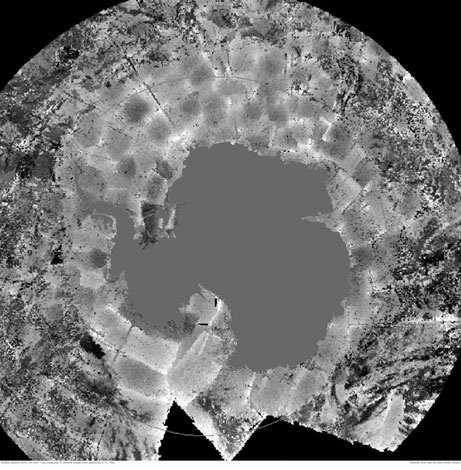
One of the striking aspects of this newly enhanced image is the amount of detail that can be seen on Earth at a resolution of perhaps 1 km/pixel taken from a quarter of a million miles away. Among the details visible is the extent of the southern polar ice cap.

The LOIRP required a lot of what has come to be called "techoarchaeology" that is, going back in time to the original data and recording devices, using modern enhancements. The expertise gained by the LOIRP team eventually caught the attention of the folks at the National Snow and Ice Data Center (NSIDC).

Data from the Nimbus weather and earth observation satellite - in orbit at the same time as the Lunar Orbiters were circling the Moon - had languished for years in the national archives until John Moses NASA Goddard Space Flight Center had them digitized.  

Dr. Walt Meir of the National Snow and Ice Data Center, after seeing the work that the LOIRP team had done in potentially identifying the Antarctic sea ice in the Lunar Orbiter 1 Earthrise image, and recognizing the similarity between the raw data of the Nimbus and Lunar Orbiter data, provided a grant to the LOIRP team to process the Nimbus data into a modern format and to correct image artifacts that are common to both types of images.  

The LOIRP team accomplished this, and rendered the images into the Google Earth format using a variety of internally developed techniques and elements of the NASA Ames developed NASA World Wind Java software development kit.

To date some of the images taken by Nimbus II have been enhanced and mapped into Google Earth. One date in particular was of interest to the LOIRP - 23 August 1966. As the images were enhanced and dropped into Google Earth it became clear that we have imagery that overlapped in time to show the weather on that late August day as evening crept up on Africa and Europe.

In New York City, just over the Earth's limb as seen from lunar orbit, the Beatles were preparing to play at Shea Stadium ...

You can download a KMZ file of these images here for viewing in Google Earth.

Related Links

- Techno-Archaeology Rescues Climate Data from Early Satellites
- LOIRP Aids In Finding Google Earth Images from 1966
- Newly Restored Lunar Orbiter Image of Earth and Moon (Detail)

The original Lunar Orbiter 1 image of Earth on 23 August 1966 (click on image to enlarge)

Nimbus II imagery of Earth on 23 August 1966 (click on image to enlarge)

Overlap of Nimbus II imagery onto Lunar Orbiter 1 imagery (click on image to enlarge)

February 4, 2010

Lunar Echoes on STS-130

The STS-130 patch was designed by the crew to reflect both the objectives of the mission and its place in the history of human spaceflight. The main goal of the mission is to deliver Node 3 and the Cupola to the International Space Station (ISS). Node 3, named "Tranquility," will contain life support systems enabling continued human presence in orbit aboard the ISS. The shape of the patch represents the Cupola, which is the windowed robotics viewing station, from which astronauts will have the opportunity not only to monitor a variety of ISS operations, but also to study our home planet.

The image of Earth depicted in the patch is the first photograph of the Earth taken from the moon by Lunar Orbiter I on August 23, 1966. As both a past and a future destination for explorers from the planet Earth, the moon is thus represented symbolically in the STS-130 patch.

The Space Shuttle Endeavour is pictured approaching the ISS, symbolizing the Space Shuttle's role as the prime construction vehicle for the ISS. The NASA insignia design for shuttle flights is reserved for use by the astronauts and for other official use as the NASA Administrator may authorize. Public availability has been approved only in the form of illustrations by the various news media. When and if there is any change in this policy, which we do not anticipate, it will be publicly announced. STS130-S-001 (September 2009) --- high res (1.5 M) low res (98 K)

October 28, 1966

Lunar Orbiter 1 Magazine Advertisements

Click for larger image

August 29, 1966

Lunar Orbiter I Mission

The Lunar Orbiter 1 robotic (unmanned) spacecraft, part of the Lunar Orbiter Program, was designed primarily to photograph smooth areas of the lunar surface for selection and verification of safe landing sites for the Surveyor and Apollo missions. It was also equipped to collect selenodetic, radiation intensity, and micrometeoroid impact data.

The spacecraft was placed in an Earth parking orbit on August 10, 1966 at 19:31 (UTC). The Trans lunar injection burn occurred at 20:04 (UTC). The spacecraft experienced a temporary failure of the Canopus star tracker (probably due to stray sunlight) and overheating during its cruise to the Moon. The star tracker problem was resolved by navigating using the Moon as a reference and the overheating was abated by orienting the spacecraft 36 degrees off-Sun to lower the temperature.

Continue reading "Lunar Orbiter I Mission" »

Lunar Orbiter 1 Mission

Alternate Names: Lunar Orbiter-A, 02394
Launch Date: 1966-08-10
Launch Vehicle: Atlas-Agena D
Launch Site: Cape Canaveral, United States
Mass: 385.6 kg
Nominal Power: 375.0 W
Launch/Orbital information for Lunar Orbiter 1
Experiments on Lunar Orbiter 1
Data collections from Lunar Orbiter 1

Description

The Lunar Orbiter 1 spacecraft was designed primarily to photograph smooth areas of the lunar surface for selection and verification of safe landing sites for the Surveyor and Apollo missions. It was also equipped to collect selenodetic, radiation intensity, and micrometeoroid impact data. The spacecraft was placed in an Earth parking orbit on 10 August 1966 at 19:31 UT and injected into a cislunar trajectory at 20:04 UT. The spacecraft experienced a temporary failure of the Canopus star tracker (probably due to stray sunlight) and overheating during its cruise to the Moon. The star tracker problem was resolved by navigating using the Moon as a reference and the overheating was abated by orienting the spacecraft 36 degrees off-Sun to lower the temperature.

Continue reading "Lunar Orbiter 1 Mission" »

August 23, 1966

NASA Wire Photo: Earthrise As Seen By Lunar Orbiter 1

NASA Caption: "First view of the earth and moon from space. Published in: Spaceflight Revolution: Langley Research Center From Sputnik to Apollo, by James R. Hansen. NASA History Series. NASA SP ; 4308. p ii. Caption: "The picture of the century was this first view of the earth from space. Lunar Orbiter I took the photo on 23 August 1966 on its 16th orbit just before it passed behind the moon. The photo also provided a spectacular dimensional view of the lunar surface." Larger image

August 18, 1966

Wire Photo Illustration of Lunar Orbiter 1 Photo Process

August 10, 1966

Lunar Orbiter 1 Postal Covers

Video; Lunar Orbiter 1 Launch

British Pathe: "L.S. Atlas Agena carrying Lunar Orbiter blasts off from Cape Kennedy (no tilt). L.S. Rocket in flight. Various animated shots showing Lunar Orbiters path and function on its journey round the moon. Various shots at deep space tracking station, California, as they lock onto Orbiter."

Photo: Liftoff of Lunar Orbiter I on 10 August 1966

Larger image

Larger image

December 4, 1965

Lunar Orbiter 1 Being Prepared for Launch

Space News
- Moontoday.net
- OnOrbit.com
- SpaceRef.com
- NASA Hackspace

About Lunar Orbiter 1 ("I" or "A")

This page contains an archive of all entries posted to MoonViews - Providing Imagery and Data For Lunar Exploration in the Lunar Orbiter 1 ("I" or "A") category. They are listed from oldest to newest.

Lunar Orbiter is the previous category.

Lunar Orbiter 2 ("II" or "B") is the next category.

Many more can be found on the main index page or by looking through the archives.

PARTICIPANTS
- NASA ESMD
- NASA IPP
- NASA ARC
- NASA Lunar Science Institute
- SpaceRef Interactive
- SkyCorp
- National Snow and Ice Data Center - USGS
- LPI
- PDS

LUNAR ORBITER
- Overview
- LPI Image Archive
- Documents

LUNAR MISSIONS
Scientific
- Apollo
- ARTEMIS - Chandrayaan-1
- Chandrayaan-2
- Chang'e-1
- Chang'e-2
- Clementine
- GRAIL - Kaguya
- Lunar Reconnaissance Orbiter
- LCROSS
- Luna
- Lunakhod
- Lunar Prospector
- Ranger
- SMART-1
- Surveyor
- Zond

Commercial
- Google Lunar X Prize


Copyright 2008
MoonViews LLC