Shop at the MoonViews Store

Main

Lunar Orbiter Archives

September 20, 2009

Lunar Orbiter's Kodak Camera Profiled

The Kodak Lunar Orbiter Camera, American Society of Cinematographers Blog

"The recent media attention given to the 40th anniversary of the Apollo 11 mission to the moon, with its dramatic restored video of Neil Armstrong’s first steps onto the lunar surface, has re-ignited our nation’s interest in extra-terrestrial exploration. But this mission would not have been possible had it not been for a series of lunar surface mapping missions that were made several years before.  It is a story that is not as dramatic as that of the first humans to walk on the moon. But it is a fascinating story, nonetheless, of the way that the entire Apollo program pushed beyond the then perceived limits of technology. And the Eastman Kodak Company was a major player."

"The recent AMIA (Association of Moving Image Archivists) symposium held at the Dunn Theater of the AMPAS Pickford Center in Hollywood featured jaw-dropping presentations by Al Sturm and Ralph Sargent of the history of this program as well as the forensic-like work to find and restore its lost images. It is this latter theme I will take up soon along with the recent new photos also taken by a high resolution Kodak digital camera."

September 10, 2009

LOIRP Releases Recovered Lunar Orbiter III Image of Surveyor 1 On the Lunar Surface

This image was taken by Lunar Orbiter III on 22 February 1967 at 5:24:14 GMT at an altitude of 54.27 km above the lunar surface. High resolution frame 3 clearly shows the Surveyor 1 spacecraft sitting on the lunar surface complete with a long shadow.

Surveyor 1 landed on the Moon on 2 June 1966 in the Ocean of Storms (Oceanus Procellarum) at 2.45 degrees South latitude, 43.22 degrees West longitude.

Larger view

This image has been recovered in its original high resolution format by LOIRP staff from original Lunar Orbiter project data tapes using restored tape drive hardware and will eventually be submitted to the PDS (Planetary Data System).

A full resolution version of this image will be placed online at the NASA Lunar Science Institute.

The Lunar Orbiter Image Recovery Project (LOIRP) is located at the NASA Ames Research Center in Moffett Field, CA. Funding and support for this project has been provided by NASA Exploration Systems Mission Directorate, NASA Innovative Partnerships Program, NASA Lunar Science Institute, NASA Ames Research Center, Odyssey Moon LLC, SkyCorp Inc., and SpaceRef Interactive Inc.

For more information on the Lunar Orbiter Image Recovery Project (LOIRP) visit http://www.moonviews.com

For information on NASA's Lunar Science Institute visit http://lunarscience.arc.nasa.gov/

For information on NASA's Exploration Systems Mission Directorate visit http://www.nasa.gov/exploration/

August 20, 2009

LOIRP and LRO Confirm That Humans Walked on the Moon

Yesterday the LRO team released a new image of the Apollo 14 landing site. You can clearly make out the paths that the crew walked as well as the location of the Apollo 14 Antares Lunar Module Descent Stage.

In June 2009 LOIRP issued its own view and analysis of this landing site - as seen by Lunar Orbiter III back in 1967.

Comparing our high resolution image of the site with that taken by LRO clearly shows no feature where Antares' Descent Stage now stands [larger image]. While the resolution of the Lunar Orbiter image (0.8 meters/pixel) would probably not reveal astronaut tracks in great detail, we're rather certain that it would have seen an object the size of Antares' Descent Stage.

As such, we're pretty certain that the Apollo 14 mission landed on the Moon!

August 19, 2009

Technoarchaeology: Finding The Right Image in a Room Full of Tapes

Image: a portion of our set of Lunar Orbiter data tapes at McMoon's - an abandoned McDonalds onsite at NASA Ames Research Park, home of the LOIRP - Lunar Orbiter Image recovery Project.

Here at the LOIRP (Lunar Orbiter Image Recovery Process) project there are two different phases of the image retrieval process that are distinct from each other. The second phase, the production of the vast majority of all the of the Lunar Orbiter images, will simply involve putting tapes on the tape drive machines, acquiring the data, and processing them into images.

However, we're still in the first phase of the project where we need to search through tapes in a painstaking fashion just to find the images we are interested in downloading. Once we find what we are looking for, downloading is a snap and can be done in a matter of hours.

Finding the images using a jumbled nomenclature and labeling system last used more than 40 years ago is part of what we call "Technoarchaeology".

Continue reading "Technoarchaeology: Finding The Right Image in a Room Full of Tapes" »

LOIRP Releases Restored Lunar Orbiter IV Image of the Lunar South Pole

This image of the Moon's south pole was taken by Lunar Orbiter IV on 16 May 1967 at 16:00:08 GMT. This image is identified as Frame 4094,high resolution subframe h1. Large craters visible in this image include Shackleton, Amundsen, and Scott.

A larger web version of this image is online here. A full, high resolution version of this image is online here at the NLSI.

August 10, 2009

LOIRP Releases Enhanced Restored Version of the "Image of the Century" Plus Additional Subframes of Crater Copernicus

This is a re-release of Life Magazine's "Image of the Century" from 1966. The performance of our hardware and software image processing methods has been significantly enhanced to remove some of the banding artifacts that are derived from imperfections in the spacecraft image scanning hardware. This image of Copernicus crater was taken from a spacecraft altitude of 45 km (27.1 miles) and is approximately 207.7 km (~125 miles) to the center of the image.

An interesting aspect to this image is that with this oblique view, recent impacts of small craters have much more brightness than older craters of the same size. This suggests the value of oblique photography in doing crater aging studies as well as multispectral remote sensing of excavated materials from the craters. You can view a larger version [900 K JPG] of this image on your screen here. You can download the full resolution image [505 MB TIFF] here at the NLSI.

Continue reading "LOIRP Releases Enhanced Restored Version of the "Image of the Century" Plus Additional Subframes of Crater Copernicus" »

Lunar Orbiter In The News

Local engineer critical to NASA's Lunar Orbiter project

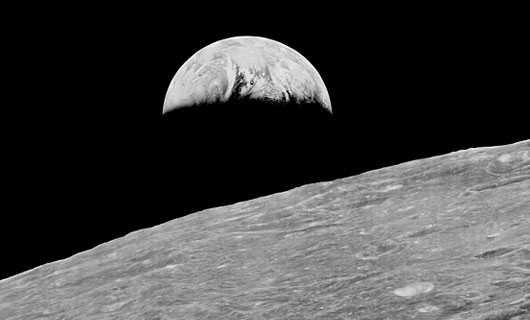
"A crescent earth appears suspended in black space in the upper portion of the image with the lunar landscape dominating the foreground. That image may have never been captured if not for a Boeing crew member who suggested turning the spacecraft around so the camera pointed toward Earth, a move not designed in the original mission playbook, explained Knittel. "It was pretty awesome," Knittel recalled about the first time he saw the photograph which was taken Aug. 23, 1966. The image transmitted back to Earth from the satellite in several separate strips of 35-mm film and was eventually assembled side by side to create the finished photo. Since the picture arrived in pieces, at first the crew monitoring its arrival only saw the moon surface and were momentarily dejected believing that the camera on board the spacecraft had missed photographing the earth, said Knittel. Then the earth's round image slowly appeared. "When they saw that picture, I understand that there were a lot of teary eyes," he said. "It was sort of like birthing a baby, I guess. It was such a big event."

August 6, 2009

LOIRP Releases Recovered Lunar Orbiter V Image of "Full Earth"

This image of Earth was taken on 8 August 1967 at 09:05:11 GMT by the Lunar Orbiter V spacecraft in orbit around the Moon at an altitude of 5,872.85 km. This image has been described as being the first image ever taken of a "full Earth" from space. [Larger image]

Lunar Orbiter V was launched on 1 August 1967 arrived in a nearly polar orbit on 5 August at 12:48 p.m. EDT. Images were taken between 6-19 August and were sent back to Earth on 27 August 1967.

Continue reading "LOIRP Releases Recovered Lunar Orbiter V Image of "Full Earth"" »

July 22, 2009

LOIRP Featured by National Geographic

MOON PICTURES: 1960s Orbiter Images Restored, National Geographic

All these steps took their toll on the quality of the images: Much like making a photocopy of a photocopy, the images of the moon created 40 years ago were fairly fuzzy and lacking in detail. But some NASA scientists had the foresight to make magnetic tape recordings of the radio-wave transmissions mid-way through the process. Now, after recovering the decades-old recordings and refurbishing outdated tape drives, a team of volunteers has begun digitizing the most famous images from the 1960s Lunar Orbiter missions with much-improved clarity and detail.

APOLLO 11: New Before-and-After Photos of Moon Bases, National Geographic

"Despite extensive restoration efforts, this photo is fuzzier and grainier than many of the restored 1960s orbiter images because of repeated viewings of the magnetic tape on which the photo was recorded."

Lunar Orbiter In The News

Kodak has played big role in space program, Democrat and Chronicle

"Kodak designed and built the cameras and film processing used in the five lunar orbiters sent to photograph the moon’s surface in 1966 and 1967 in preparation for the manned landing. Those orbiters shot panoramic strips of the lunar surface and transmitted them back to Earth before the orbiters crashed into the moon, said Todd Gustavson, curator of technology at the George Eastman House."

To the Moon - with extreme engineering - Spontaneous, improvised - would it be allowed to happen now?, The Register

"It's a temptation, watching many of the 40th Anniversary retrospectives, to think of the Apollo space program as a triumph of power and industrial might. The superpowers' space programs were, of course, political and chauvinistic, designed to showcase national wealth. But there's a better way of looking at the program, Dennis Wingo reminded me recently. Masses of money helped put man on the Moon of course, but the Moon program is really a tale of engineering improvisation and human organisation. ... The Lunar Orbiter astonishes even today. It had to take pictures, scan and develop the film on board, and broadcast it successfully back to earth. Naturally, the orbiter had to provide its own power, orient itself without intervention from ground control, and maintain precise temperature conditions and air pressure for the film processing, and protect itself from solar radiation and cosmic rays - all within severe size and weight constraints. This was far beyond the capabilities of the newest spy satellites, which back then returned the film to earth in a canister, retrieved by a specially kitted-out plane. The Orbiter challenge was the Apollo challenge in miniature."

July 17, 2009

Damaged Tape and Murky Moon Views

Image: Our retrieved image with the location of Apollo 11's Eagle Descent Stage.

With the 40th anniversary of Apollo 11's landing on the Moon upon us, everything old is new - or so it would seem. Yesterday we saw digitally re-mastered footage released showing the first steps on the Moon in unprecedented clarity. Also this was made from a copy that itself was a copy. The original video, recorded live as the Moon walks were underway has slipped into history - either misfiled or, more likely, erased and reused years later - much like a floppy disk. That said, the new footage does provide a window into the past with detail heretofore unseen.

Another place where windows are being opened into the past is the Lunar Orbiter Image Recovery Project (LOIRP) housed at NASA Ames Research Center. Utilizing ancient FR-900 tape drives, thousands of pounds of long forgotten image tapes, lots of loaned help including retired engineers and scientists, some money (from NASA ESMD, ARC, IPP, and NLSI, SkyCorp, and SpaceRef Interactive, and Odyssey Moon) and an old abandoned McDonalds restaurant (it was available - we call it "McMoons"), we've been able to bring these images back to life at resolutions greater than ever seen before. In many cases, until Lunar Reconnaissance Orbiter (LRO) takes new images, thee tapes represent the highest resolution images of the Moon ever taken from orbit.

As we ponder the sad news that the original Apollo 11 video has been lost, it is important to note that our Lunar Orbiter tapes might otherwise have been destroyed several years ago had not a stop order been placed on their destruction due to NASA's search for Apollo 11 tapes and data. One project's sad news is another's execution reprieve.

Among our successes has been bringing the iconic Earthrise and Copernicus back to life in unprecedented detail. This time we need to report a major disappointment.

We recently released two Apollo landing site images - Apollo 12 and Apollo 14 and had embarked upon getting an nice crisp image of the Apollo 11 landing site in time for the anniversary.

Alas, unlike the unprecedented resolution we obtained for these two sites, Apollo 11 was a let down. The image is murky and far less clear than previous images. This is not due to the Lunar Orbiter spacecraft or our restored hardware. Rather, we expect, it had to do with someone playing this tape years ago and getting it jammed for an instant. Alas, the interesting part of this tape is framelet 411 which shows the Apollo 11 landing site. So, if there was a natural place on this tape to be paused, rewound, and played again and again and again, it is this location. Little surprise that the chance for damage to this portion of the tape occurred.

Our collection of tapes covers the entire five mission Lunar Orbiter project. While we are getting better at deciphering the nomenclature and labeling on the tapes, we still have much to learn. We can now find a specific tape and image in a straight forward process but have still only scratched the surface. And, paradoxically, we seem to have more tapes marked "Lunar Orbiter V" than we need to contain all of the images from that mission. We suspect that we have two (or more) archival collections mixed in or (for some reason) multiple copies of the same images. The only way to know for sure is to look at every tape - one by one.

The path to getting this Apollo 11 landing site image was complicated. The image was taken by Lunar Orbiter V on 12 August 1967 at 22:21:13.809 GMT at an altitude of 98. km. Properly retrieved, the resolution of our image should be 2.387 meters per pixel.

After our first round of image retrievals, the heads for our FR-900 tape drive needed to be refurbished. This is an expensive and time consuming process with only one or two places in the world capable of doing it. With the heads refurbished we were prepared to run the tape. As we did we found out that our custom made frame grabber had a bad chip which needed to be replaced.

Once the gear was good to go, the process of running the tape began. There was an ominous note on the tape can that a section of the tape might be damaged. We soon discovered that indeed there was some damage to a 4 minute segment and it was the portion we were most interested in.

Undaunted, Ken Zin, our experienced video tape drive engineer, Al Sturm our electronics guru, and Austin Epps, our vigilant student intern worked long hours to get everything working to see what sort of image we could get. Austin ran the tape multiple times os as to get multiple images we could use to produce a super resolution image of the landing site.

Despite this attempt to coax a little clarity out of the noise, the damage to the tape precluded an image of the quality we had hope for - and had achieved for other images. That disappointment aside, we feel that it is important to show our failures and disappointments as well as our crowning achievements. As you will see when you compare it to the best Lunar Orbiter images, the resolution is low. Yet if you compare it with the new LRO images you can clearly see that something appeared in the image and that the regolith was disturbed around that object (humans).

We will be combing through the Lunar Orbiter tapes this weekend with the hope that there is another (hopefully undamaged) version of this image.

We feel that it is equally important to reveal our failures and disappointments as it is to crow about our successes. We expect to have many of both.

Such is the curse of Apollo 11 - for an event so epic in its nature, the frail means where by we captured it and the planning that led up to it - are fleeting. One more reason why all of this fragile history needs to be maintained with constant vigilance - else we lose all of this to the dust of time.

For more information on the Lunar Orbiter Image Recovery Project (LOIRP) visit http://www.moonviews.com

For information on NASA's Lunar Science Institute visit http://lunarscience.arc.nasa.gov/

Figure 1 Our retrieved image with the location of Apollo 11's Eagle Descent Stage.

Figure 2 Comparing our retrieved image and that scanned by the USGS

Figure 3 Comparing our retrieved image, one scanned by the USGS, and LRO's recent image.

June 15, 2009

Lunar Orbiter Image Recovery Project (LOIRP) Releases New Image of Apollo 12/Surveyor III Landing Site

This image LO3-154-H was taken by Lunar Orbiter III on 20 February 1967 and shows the landing site for both Surveyor III (landed 20 April 1967) and Apollo 12 (landed 19 November 1969).

Figure 1 shows the region without labels. Figure 2 shows major features plus EVA routes.

Figure 1: Apollo 12/Surveyor III landing site as seen by Lunar Orbiter III (larger image)

Figure: 2 Apollo 12/Surveyor III landing site as seen by Lunar Orbiter III with prominent features and EVA routes (larger image)

This image has been recovered in its original high resolution format from original Lunar Orbiter project data tapes using restored tape drive hardware and will eventually be submitted to the PDS (Planetary Data System).

LOIRP Note: We will be putting the full resolution version of this image on the NASA Lunar Science Institute website with the layers preserved for Photoshop for all you folks to have fun with! We only ask that you send us copies of what you do and credit us if you publish it anywhere.

For more information on the Lunar Orbiter Image Recovery Project (LOIRP) visit http://www.moonviews.com

For information on NASA's Lunar Science Institute visit http://lunarscience.arc.nasa.gov/

June 14, 2009

Lunar Orbiter Image Recovery Project (LOIRP) Releases New Image of the Moon's South Pole

This image was taken by Lunar Orbiter IV in May 1967 and shows the south pole of the Moon. Figure 1 shows the region without labels. Figure 2 shows major features plus notation regarding processing artifacts from the spacecraft's film processing system. The moon's south pole is located near the rim of Shackleton Crater.

Adjacent to the south pole is Shoemaker crater named in honor of famed planetary geologist Eugene Shoemaker. The Lunar Prospector spacecraft, carrying some of Shoemaker's ashes, was deliberately crashed in this crater in an attempt to see if any water ice would be thrown up by the impact.

The Lunar CRater Observation and Sensing Satellite (LCROSS) will be targeted to impact at the south pole of the moon. As such, the moon's polar regions are of great interest right now.

Figure 1 South Pole of the moon as seen by Lunar Orbiter IV (larger image)

Figure 2 South Pole of the moon as seen by Lunar Orbiter IV with prominent features and processing artifacts identified (larger image)

This image has been recovered in its original high resolution format from original Lunar Orbiter project data tapes using restored tape drive hardware and will eventually be submitted to the PDS (Planetary Data System).

LOIRP Note: We will be putting the full resolution version of this image on the NASA Lunar Science Institute website with the layers preserved for Photoshop for all you folks to have fun with! We only ask that you send us copies of what you do and credit us if you publish it anywhere.

For more information on the Lunar Orbiter Image Recovery Project (LOIRP) visit http://www.moonviews.com

For information on NASA's Lunar Science Institute visit http://lunarscience.arc.nasa.gov/

June 9, 2009

Lunar Orbiter Image Recovery Project (LOIRP) Releases New High Resolution Image of the Ocean of Storms

Larger version

The Lunar Orbiter Image Recovery Project (LOIRP) has released a newly-retrieved, high resolution image taken of the lunar surface 42 years ago.

This image was taken by Lunar Orbiter III (LPI data) in February 1967. This oblique photo shows the region around the crater Galilaei and Planitia Descensus in Oceanus Procellarum (the Sea of Storms). In the upper center of the image you can see the Great Wall of Procellarum.

This image has been recovered in its original high resolution format from original Lunar Orbiter project data tapes using restored tape drive hardware and will eventually be submitted to the PDS (Planetary Data System).

LOIRP Note: We will be putting the full resolution version of this image on the NASA Lunar Science Institute website with the layers preserved for Photoshop for all you folks to have fun with! We only ask that you send us copies of what you do and credit us if you publish it anywhere.

For more information on the Lunar Orbiter Image Recovery Project (LOIRP) visit http://www.moonviews.com

For information on NASA's Lunar Science Institute visit http://lunarscience.arc.nasa.gov/

April 12, 2009

KTVU: Old NASA Tapes Reveal Stunning New Moon Images; Resolution Unparalleled

Old NASA Tapes Reveal Stunning New Moon Images; Resolution Unparalleled

KTVU looked at several images, and the detail and clarity are astonishing. It's the difference between grainy 35mm film with several generations of degradation, and the 70mm film original.

"Dennis Wingo brought up NASA's publicly released photo from August 23, 1966, called "Earthrise." Time Magazine called it the "Photo of the Century" and it is certainly amazing even today. But on the next screen Wingo showed the digitized version from the original tracking station tapes. Zooming in on the first version, Earth looks a bit fuzzy, though you can make out cloud patterns. On the recovered version, you can see fog along the Chilean coast, ice floes near the Antarctic. It is truly astonishing.

"Using these and some other 1966 images, we may be able to help push NASA's climate data back in time a full decade, which will help with climate change studies," says Wingo.

On shots of the lunar surface, the first versions show a blurry shadow here, some grayish along the horizon. The digitized recovered image is crisp with the deep black of space hovering over a multi-shaded gray surface, almost as if you were looking out the window of some lunar highrise. You can see rocks the size of an office chair. Sharp shadows and almost a 3D effect."

Full story and Video at KTVU

March 16, 2009

What Lunar Orbiter 1 Was Seeing on 23 August 1966

Dennis Wingo and Keith Cowing at the LOIRP have been working to understand exactly what Lunar Orbiter 1 saw as it looked back at Earth on 23 August 1966. When LOIRP released its first retrieved image last year they included some attempts to correlate the Earth with rough boundries. In so doing they discovered that the time estimated back in 1966 was off by an hour or so. Dennis has now taken another stab at trying to understand what we all saw when Lunar Orbiter took this portrait of Earth. Click on image to enlarge. Image copyright 2009 LOIRP. Permission required for republication.

Image Archives

November 23, 2008

Recovered Lunar Orbiter Image makes Lunar Photo of the Day

Lunar Photo of the Day

"With much fanfare NASA has re-released the earliest US image of the Earth as seen from the Moon. This Orbiter 1 image was originally released in 1966 when it was a unique, never before seen view that dramatically documented our new prowess in space. The recent re-release follows a long saga of saving and repairing the large 40 year old tape drives needed to read the massive tapes that record the data."

November 21, 2008

NASA Earth Observatory Features Recovered Lunar Orbiter Image

Earthrise 1966, NASA Earth Observatory

"Long before man journeyed to the moon and looked back at the tiny, fragile planet that houses humanity, remote orbiters were sending back pictures of home. Sent to scope out potential landing sites on the Moon, the series of five Lunar Orbiters also sent back the earliest views of Earth from another celestial body. This image, taken in 1966 by Lunar Orbiter 1, is among the first views of Earth from the Moon. In the black-and-white image, a crescent Earth floats majestically behind the lumpy surface of the Moon. Though clouds swirl across the atmosphere, hiding nearly all identifying features on the surface beneath, the western edge of Africa is faintly visible in the upper left. The Earth's North Pole points toward the top of the image."

November 20, 2008

Wikipedia Update on Lunar Orbiter Imagery

Revised Wikipedia entry on Lunar Orbiter

"In 2007, the Lunar Orbiter Image Recovery Project (LOIRP) began a process to convert the Lunar Orbiter Images directly from the original analog video recordings of the spacecraft data to digital image format, a change which provided vastly improved resolution over the original images released in the 1960s. The first of these restored images were released in late 2008."

November 19, 2008

Video of Lunar Orbiter Image Release Press Conference

This video features a press Conference held at NASA Ames Research Center on 13 November 2008 where our first recovered Lunar Orbiter image was unveiled and discussed.

November 18, 2008

A Reborn Picture Spawns an Editorial

The Moon View, editorial, New York Times

"Last week, NASA released a newly restored image of a younger Earth. It was taken from Lunar Orbiter 1 in 1966, the first of several orbiters that helped gather data for the first moon landing in 1969. The photograph shows Earth just cresting the Moon’s curving horizon, the first picture of our planet framed by the surface of the Moon. When the photograph was published, in 1966, it looked like a newsprint version of a high-contrast snapshot from space, a stark scattering of whites and blacks. The data from the lunar orbiter was stored on old analog tape drives. Now, imaging experts at NASA have digitized those drives — mining data that could not be recovered when they were first made — and produced a high-resolution version of that historic photograph."

Lunar Orbiter in the News 18 November 2008

The Earth As First Seen From The Moon, Editorial Photographer

"When I was young and the first photographs from our space missions began to appear, I was fasinated by their mystery and grace. Science fiction was one of my passions then. When the Whole Earth Catalog began to publish the used this imagery to capture out attention and it is really our generation that had been the first to witness such sights."

Restored for posterity: The historic moment Earth was pictured from space for the first time, Daily Mail

"Later, clearer images would continue to inspire mankind, bringing back more and more images of Earth from space, but this is the one which captures the very second humanity gazed down on itself for the first time. And the image, showing the start of man's achievements in space, was followed less than a fortnight later by a vision of man's dreams for the future - when the first episode of Star Trek aired on September 8."

This is why I get a kick out of archiving!, Serendipityoucity

"These lunar images and the later great blue ball images sparked a whole new way for us to see ourselves, to think of a borderless world, to imagine ourselves in space, to think about transboudary environmental issues, and most importantly reminded us that we are all in this together."

Stuff on the Web: NASA goes back to the future, 4P Photoblog

"That NASA is restoring these images makes a lot of sense to me. They should contain quite a bit of information that will be crucial to the current Lunar program. The quality of the images though looks to be astonishing, and is a credit to the original designers of the Lunar Orbiters."

Endeavour Update; Low Power Plan For Spirit, Astronomy Weather Blog, AccuWeather.com

"I have a profound interest in photography, so when I read about how NASA had restored a 42-year old image, I had to share the story! There is a great picture that was taken by the Lunar Orbiter 1 in 1966 that depicts Earth rising above the lunar surface. Modern digital technology has allowed NASA to produce the image at much higher resolutions. In the 1960s, limited technology of the day prevented the full, true resolution of the images from being available as they were captured on large magnetic types and transferred to photographic film."

November 17, 2008

Recovered Lunar Orbiter Image Makes Astronomy Picture of the Day

Restored: First Image of the Earth from the Moon:

"Explanation: Pictured above is the first image ever taken of the Earth from the Moon. The image was taken in 1966 by Lunar Orbiter 1 and heralded by then-journalists as the Image of the Century. It was taken about two years before the Apollo 8 crew snapped its more famous color cousin. Recently, modern technology has allowed the recovery of higher resolution images from old data sources such as Lunar Orbiter tapes than ever before. Specifically, recovery of the above image was initiated 20 years ago by Nancy Evans, and completed recently by Dennis Wingo and Keith Cowing who lead the Lunar Orbiter Image Recovery Project. Lunar Orbiter Image Recovery Project. Images like that above carry more than aesthetic value -- comparison to recent high definition images of the Moon enables investigations into how the Moon has been changing."

This Week at NASA - November 14, 2008 - Featuring LOIRP

Note: The LOIRP segment starts at 2:14

November 16, 2008

Lunar Orbiter Image Hacks

Colorized wallpaper via Gizmodo

iPhone background version via Gizmodo

November 13, 2008

Retrieving Lunar Orbiter Images

This video shows a Lunar Orbiter image framelet being retrieved from an original data tape using a restored FR-900 tape drive. Watch the monitor between the two tape drives as portions of the image (negative image) roll across the screen. This activity is part of the Lunar Orbiter Image Recovery Project (LOIRP) underway at NASA ARC.

Newly Restored Lunar Orbiter Image of Earth and Moon

Newly restored Lunar Orbiter 1 image. Originally taken on 23 August 1966 and restored by the Lunar Orbiter Image Recovery Project at NASA Ames Research Center. Center portion containing Earth has undergone a second level of processing to remove frame lines from the image. Larger image. Credit: NASA/LOIRP

Video: Equipment used to restore images.

Newly Restored Lunar Orbiter Image of Earth and Moon (Detail)

Portion of newly restored Lunar Orbiter 1 image. Originally taken on 23 August 1966 and restored by the Lunar Orbiter Image Recovery Project at NASA Ames Research Center. Larger image. Credit: NASA/LOIRP

How the Photo Was Taken

This chart from the 1960's shows the context of the newly restored Lunar Orbiter 1 image. This image was taken on 23 August 1966 and restored by the Lunar Orbiter Image Recovery Project at NASA Ames Research Center. The orientation of Earth was slightly off and shows a terminator about an hour off from what is actually in the image.Larger image. Credit: NASA/LOIRP


This graphic shows the actual orientation of Earth at the time the photo was taken. It was possible to match the outlines of north Africa in the newly restored image. Larger image. Credit: NASA/LOIRP

Seeing Clouds Shadows On Earth

This graphic compares the enhanced resolution of the LOIRP image and the highest resolution image available online at LPI. AT full resolution shadows can be seem between clouds and the Earth's surface at a resolution estimated to be around 1 kilometer per pixel. This image was taken on 23 August 1966 and restored by the Lunar Orbiter Image Recovery Project at NASA Ames Research Center. Larger image. Credit: NASA/LOIRP

Comparing USGS and LOIRP Image Resolution

Several years ago the USGS Astrogeology Research Program began a project whereby copies of original Lunar Orbiter photos have been scanned using high resolution scanning devices. This graphic compares the calibration marks from a high resolution USGS scan and an inital image generated by the LOIRP. Larger image. Credit: NASA/USGS/LOIRP

Greater Surface Detail

This graphic compares the enhanced resolution of the LOIRP image and the highest resolution image available online at LPI. This image was taken on 23 August 1966 and restored by the Lunar Orbiter Image Recovery Project at NASA Ames Research Center. Larger image. Credit: NASA/LOIRP

Increase in Resolution

This graphic compares the enhanced resolution of the LOIRP image and the highest resolution image available online at LPI. Note the substantial increase in resolution with regard to the calibration marks at the bottom of this image. This image was taken on 23 August 1966 and restored by the Lunar Orbiter Image Recovery Project at NASA Ames Research Center. Larger image. Credit: NASA/LOIRP

Space News
- Moontoday.net
- OnOrbit.com
- SpaceRef.com
- ColabSpace

About Lunar Orbiter

This page contains an archive of all entries posted to MoonViews - Providing Imagery and Data For Lunar Exploration in the Lunar Orbiter category. They are listed from oldest to newest.

LRO is the previous category.

Lunar Orbiter Camera is the next category.

Many more can be found on the main index page or by looking through the archives.

PARTICIPANTS
- NASA ESMD
- NASA IPP
- NASA ARC
- NASA LSI
- ACES
- SpaceRef Interactive
- SkyCorp
- Odyssey Moon
- USGS
- LPI
- PDS

LUNAR ORBITER
- Overview
- Images
- Documents

LUNAR MISSIONS
Scientific
- Apollo
- Chandrayaan-1
- Chang'e-1
- Clementine
- Kaguya
- Lunar Reconnaissance Orbiter
- LCROSS
- Luna
- Lunakhod
- Lunar Prospector
- Ranger
- SMART-1
- Surveyor
- Zond

Commercial
- Google Lunar X Prize


Copyright 2008
MoonViews LLC