Shop at the MoonViews Store

Main

Images Archives

March 11, 2010

Dumpster Diving for Science

NASA Dives Into Its Past to Retrieve Vintage Satellite Data, Science (subscription)

"Last month, researchers working out of an abandoned McDonald's restaurant on the grounds of NASA Ames Research Center recovered data collected by NASA's Nimbus II satellite on 23 September 1966. The satellite soared over Earth in a polar orbit every 108 minutes, taking pictures of cloud cover and measuring heat radiated from the planet's surface, and creating a photo mosaic of the globe 43 years ago. The resulting image is the oldest and most detailed from NASA's Earth-observing satellites. It's also the latest success story in what researchers call techno-archaeology: pulling data from archaic storage systems. Once forgotten and largely unreadable with modern equipment, old data tapes are providing researchers with new information on changes in the surfaces of Earth and the moon..."

... The LOIRP team obtained $750,000 from NASA and private enterprise and enlisted the assistance of a retired Ampex engineer. They cleaned, rebuilt, and reassembled one drive, then designed and built equipment to convert the analog signals into an exact 16-bit digital copy. "It was like dumpster diving for science," says Cowing, co-team leader at LOIRP. In November 2008, the team recovered their first image: a famous picture of an earthrise taken by Lunar Orbiter 1 on 23 August 1966. The team's new high-resolution version was so crisp and clear that it revealed many previously obscured details, such as a fog bank lying along the coast of Chile. "We thought if the Earth's surface looks that good a quarter of a million miles away, what does the moon's surface look like 100 miles beneath it?" says Cowing."

Click on image to enlarge

March 10, 2010

Nimbus II and Lunar Orbiter 1 Imagery: A New Look at Earth in 1966

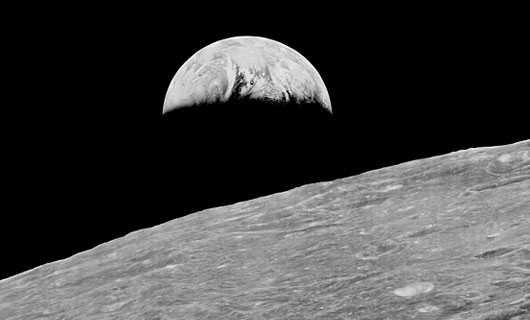
On 23 August 1966, the Lunar Orbiter 1 spacecraft took a photo of the Earth as seen from lunar orbit. This image, albeit grainy, quickly became an icon of the Space Age. This "earthrise" photo, while spectacular at the time, was never retrieved and processed to the full level of detail contained in the image. This was due in great part of the available technology at the time. Computer image processing was in its infancy.

Forty two years later, the Lunar Orbiter Image Recovery Project (LOIRP) managed to retrieve the image from original data tapes using restored tape drives from the 1960s. In so doing the level of detail present in the image was unparalleled. Subsequently, other images have been retrieved with the ultimate goal of obtaining all of the images returned by the five Lunar Orbiters.

One of the striking aspects of this newly enhanced image is the amount of detail that can be seen on Earth at a resolution of perhaps 1 km/pixel taken from a quarter of a million miles away. Among the details visible is the extent of the southern polar ice cap.

The LOIRP required a lot of what has come to be called "techoarchaeology" that is, going back in time to the original data and recording devices, using modern enhancements. The expertise gained by the LOIRP team eventually caught the attention of the folks at the National Snow and Ice Data Center (NSIDC).

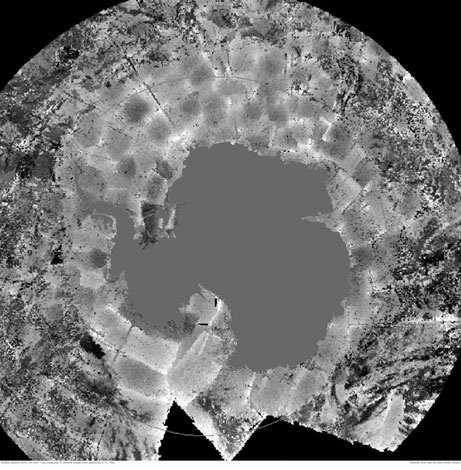
Data from the Nimbus weather and earth observation satellite - in orbit at the same time as the Lunar Orbiters were circling the Moon - had languished for years in the national archives until John Moses NASA Goddard Space Flight Center had them digitized.  

Dr. Walt Meir of the National Snow and Ice Data Center, after seeing the work that the LOIRP team had done in potentially identifying the Antarctic sea ice in the Lunar Orbiter 1 Earthrise image, and recognizing the similarity between the raw data of the Nimbus and Lunar Orbiter data, provided a grant to the LOIRP team to process the Nimbus data into a modern format and to correct image artifacts that are common to both types of images.  

The LOIRP team accomplished this, and rendered the images into the Google Earth format using a variety of internally developed techniques and elements of the NASA Ames developed NASA World Wind Java software development kit.

To date some of the images taken by Nimbus II have been enhanced and mapped into Google Earth. One date in particular was of interest to the LOIRP - 23 August 1966. As the images were enhanced and dropped into Google Earth it became clear that we have imagery that overlapped in time to show the weather on that late August day as evening crept up on Africa and Europe.

In New York City, just over the Earth's limb as seen from lunar orbit, the Beatles were preparing to play at Shea Stadium ...

You can download a KMZ file of these images here for viewing in Google Earth.

Related Links

- Techno-Archaeology Rescues Climate Data from Early Satellites
- LOIRP Aids In Finding Google Earth Images from 1966
- Newly Restored Lunar Orbiter Image of Earth and Moon (Detail)

The original Lunar Orbiter 1 image of Earth on 23 August 1966 (click on image to enlarge)

Nimbus II imagery of Earth on 23 August 1966 (click on image to enlarge)

Overlap of Nimbus II imagery onto Lunar Orbiter 1 imagery (click on image to enlarge)

February 5, 2010

National Snow and Ice Data Center on LOIRP

Techno-Archaeology Rescues Climate Data from Early Satellites, National Snow and Ice Data Center

Image: Forty-three years after the Nimbus II satellite collected these data, a team from NSIDC and NASA recovered a global image from September 23, 1966. In this view over Antarctica, overlaid on Google Earth, the Ross Ice Shelf appears clearly at left.

"Starting with the methods developed for the Lunar Orbiter Image Recovery Project (LOIRP) at NASA Ames Research Park, a team at NSIDC worked with Dennis Wingo at LOIRP to search NASA archives for the original Nimbus tapes containing raw images and calibrations. Their first goal was to read and reprocess the data at a higher resolution, removing errors resulting from the limits of the original processing."

February 4, 2010

LOIRP Aids In Finding Google Earth Images from 1966

Technoarcheology and Earth Sciences, the Recovery of Nimbus II High Resolution Infrared Radiometer Data

"In 2008 the Lunar Orbiter Image Recovery Project (LOIRP) began a NASA ESMD sponsored project to resurrect 43+ year old Ampex FR-900 instrumentation tape drives for the purpose of recovering, before the capability to do so becomes impossible, the last surviving master tapes from the five Lunar Orbiter spaceraft that orbited the Moon in support of Apollo in 1966-67. Our project is proceeding on our task to do so. During our research on the Ampex tape drives we scoured the NASA Technical Reports Server as well as any other source we could get our hands on. During this search, we found, through a Cadillac (yes the car) user group, a gentleman from Alaska who had worked on these drives during the 1960's. We were able to connect and while he had retired and the units were long gone to that great scrap yard in the sky, he told me something interesting. He said that during his time working on the drives that they had sent "miles and miles, thousands of tapes" to NASA during the Nimbus weather satellite program. This is where our new tale begins."

"One of the things that the LOIRP team is going to do is to take the Nimbus II HRIR data from August 23rd 1966 and overlay that with the Lunar Orbiter 1 data on the same date for a composite mosaic. There is potential for a significant synergy between Lunar Orbiter, Apollo, and Nimbus II and III data sets. This type of synergy could provide many benefits to the Earth sciences community."

December 11, 2009

The Boulders of Copernicus

This image represents a portion of the central uplift within the crater Copernicus. The image, LOV-152-H1, was taken by Lunar Orbiter V on 16 August 1967 at an altitude of 103 km. The spacecraft was looking straight down at the crater as it snapped this picture series. The resolution of this image is 2.2 meters/pixel. [Click on image to enlarge]

Below, you can see the increase in contrast and resolution that LOIRP has attained when you compare the high resolution USGS image (left) and the one obtained by LOIRP on 10 December 2009 (right). [Click on image to enlarge]

December 10, 2009

Live Webcast From McMoon's

Keith's note: On Thursday, 10 December 2009, we conducted a live webcast from the Lunar Orbiter Image Recovery Project (LOIRP) at "McMoon's" i.e. Building 596 at the NASA Ames Research Park.

Dennis Wingo and I give you a tour of our project including a walk through of the abandoned McDonald's that has been our base of operations since 2008. We show you how we rack tapes, play them back, capture the data on a computer, and then stitch the image framelets together. You can look over our shoulders and see the imagery as it appears on one of our old TV monitors. We've picked an especially interesting tape to show you. Eventually this image will be posted online at LPI and submitted to the NSSDC.

This project has been funded and supported by a bunch of imaginative folks at ESMD, IPP, NLSI, ARC, SkyCorp, SpaceRef Interactive, and Odyssey Moon with assistance from a range of people ranging from retired Lunar Orbiter project personnel and Lockheed Martin employees to local high school and college students. Soon, we expect to have two tape drives fully operational and to be able to produce images on a daily basis.

Oh yes, in case you are wondering, I donate my time (and money) to this project. What fun. Its like bringing a time machine back to life in a high tech junkyard. We are looking to begin some pervasive EPO in coordination with NLSI and the Challenger Center for Space Science Education in the very near future.

December 9, 2009

Boulder Trails On The Moon

[Click on image to enlarge] Keith's note: This image was taken on 21 November 1966 by Lunar Orbiter II at an altitude of 44 miles. The image is taken from frame 92, Framelet 445, and has resolution is 0.98 meters/pixel. As such the large boulder that has left a trail is around 6-7 meters in diameter. The image on the left shows the highest resolution image available online at LPI. On the right is the raw unproceesed image we retrieved this afternoon. While the large boulder's trail is seen in both images, the details of that trail and the rest of the boulder field are much sharper in our newly retrieved image.

By coincidence this large boulder is very similar in size to "House Rock" a large boulder north of the Haughton Mars Research Station on Devon Island. That's me standing on top if it.

This rock is a favorite place to pose for photos and was named after the large rock that Astronaut Jack Schmitt posed next to during the Apollo 17 mission.

Comparing USGS, LPI, and LOIRP Image Resolution (Update)

[Click to enlarge] Keith's note: These images are taken from Lunar Orbiter II image LOII_092H1 Framelet 522. On the left is the highest resolution scanned version available online at LPI (or USGS). On the right is our partially processed version that we retrieved this morning. In addition to providing a much sharper image, note that our new image also allows contrast to be controlled such that features can seen in the areas that are darkened in the older image.

Right now we are focusing on retrieving Lunar Orbiter II images at the request of both LPI and USGS since high resolution (modern) scans have yet to be done for this mission's images. We hope to have the entire image online later today complete with collapsed lava tubes (?) and giant boulders sitting in the middle of otherwise flat plains. With our recently enhanced (restored) original FR-900 tape drive and its recently restored sister drive we will soon have two fully functional drives in operation and will be able to (eventually) retrieve and release images on a daily basis.

I will be doing a live webcast tomorrow at 1pm PST wherein we give you a tour of our facility and watch as we pull a new image back from history and into the present. Details to follow.

December 7, 2009

Seeing Boulders on The Moon

[Click on image to enlarge] Keith's note: Tonight we are testing out our newest Mac computer at the Lunar Orbiter Image Recovery Project located at NASA ARC. We'll be using this machine (8 processors and 10 TB of storage) to do near-real time processing of imagery once we have pulled it off of original Lunar Orbiter analog data tapes using our restored FR-900 tape drives. We hope to do a live webcast this coming Thursday so that you can look over our shoulders as we bring another image to light for the first time in more than 40 years.

Tonight, as we were flying through a portion of one of the images we came across a boulder field. Here is the image archive at LPI - subframe H3, Framelet 323. The image was taken by Lunar Orbiter II on 20 Nov 1966 at an altitude of 52.2 miles with a ground resolution of 1.14 meters/pixel. The framelet image shown here is approximately 220 meters across. You can clearly make out a number of boulders around 1 meter in size sitting on the surface.

September 10, 2009

LOIRP Releases Recovered Lunar Orbiter III Image of Surveyor 1 On the Lunar Surface

This image was taken by Lunar Orbiter III on 22 February 1967 at 5:24:14 GMT at an altitude of 54.27 km above the lunar surface. High resolution frame 3 clearly shows the Surveyor 1 spacecraft sitting on the lunar surface complete with a long shadow.

Surveyor 1 landed on the Moon on 2 June 1966 in the Ocean of Storms (Oceanus Procellarum) at 2.45 degrees South latitude, 43.22 degrees West longitude.

Larger view

This image has been recovered in its original high resolution format by LOIRP staff from original Lunar Orbiter project data tapes using restored tape drive hardware and will eventually be submitted to the PDS (Planetary Data System).

A full resolution version of this image will be placed online at the NASA Lunar Science Institute.

The Lunar Orbiter Image Recovery Project (LOIRP) is located at the NASA Ames Research Center in Moffett Field, CA. Funding and support for this project has been provided by NASA Exploration Systems Mission Directorate, NASA Innovative Partnerships Program, NASA Lunar Science Institute, NASA Ames Research Center, Odyssey Moon LLC, SkyCorp Inc., and SpaceRef Interactive Inc.

For more information on the Lunar Orbiter Image Recovery Project (LOIRP) visit http://www.moonviews.com

For information on NASA's Lunar Science Institute visit http://lunarscience.arc.nasa.gov/

For information on NASA's Exploration Systems Mission Directorate visit http://www.nasa.gov/exploration/

August 20, 2009

LOIRP and LRO Confirm That Humans Walked on the Moon

Yesterday the LRO team released a new image of the Apollo 14 landing site. You can clearly make out the paths that the crew walked as well as the location of the Apollo 14 Antares Lunar Module Descent Stage.

In June 2009 LOIRP issued its own view and analysis of this landing site - as seen by Lunar Orbiter III back in 1967.

Comparing our high resolution image of the site with that taken by LRO clearly shows no feature where Antares' Descent Stage now stands [larger image]. While the resolution of the Lunar Orbiter image (0.8 meters/pixel) would probably not reveal astronaut tracks in great detail, we're rather certain that it would have seen an object the size of Antares' Descent Stage.

As such, we're pretty certain that the Apollo 14 mission landed on the Moon!

August 19, 2009

Technoarchaeology: Finding The Right Image in a Room Full of Tapes

Image: a portion of our set of Lunar Orbiter data tapes at McMoon's - an abandoned McDonalds onsite at NASA Ames Research Park, home of the LOIRP - Lunar Orbiter Image recovery Project.

Here at the LOIRP (Lunar Orbiter Image Recovery Process) project there are two different phases of the image retrieval process that are distinct from each other. The second phase, the production of the vast majority of all the of the Lunar Orbiter images, will simply involve putting tapes on the tape drive machines, acquiring the data, and processing them into images.

However, we're still in the first phase of the project where we need to search through tapes in a painstaking fashion just to find the images we are interested in downloading. Once we find what we are looking for, downloading is a snap and can be done in a matter of hours.

Finding the images using a jumbled nomenclature and labeling system last used more than 40 years ago is part of what we call "Technoarchaeology".

Continue reading "Technoarchaeology: Finding The Right Image in a Room Full of Tapes" »

LOIRP Releases Restored Lunar Orbiter IV Image of the Lunar South Pole

This image of the Moon's south pole was taken by Lunar Orbiter IV on 16 May 1967 at 16:00:08 GMT. This image is identified as Frame 4094,high resolution subframe h1. Large craters visible in this image include Shackleton, Amundsen, and Scott.

A larger web version of this image is online here. A full, high resolution version of this image is online here at the NLSI.

Video: Pulling Lunar Orbiter Images Off of Original Data Tapes

Austin Epps sitting in the LOIRP lab at "McMoons" at NASA Ames Research Center downloading imagery from an original Lunar Orbiter data tape using a restored FR-900 tape drive on 18 August 2009

August 18, 2009

Correcting Our South Pole Selenography

"I have been involved in the illumination analysis of the lunar south pole for a while and your reference image (http://images.spaceref.com/news/2009/LO-IV-179-H1.label.jpg) seemed incorrect based on going over such images so many times.  I checked it against Clementine imagery and it turns out that the labels you have are in the wrong places.  I have attached a jpeg of the correct placements for the South Pole and Shackleton." - James Fincannon, NASA GRC

August 13, 2009

LOIRP Releases Restored Image of Lunar South Pole

This image, LO-IV-179-H1, taken by Lunar Orbiter IV on May 24, 1967 at 16:19:23.809 GMT, shows a portion of the lunar south polar region. A much larger version [1.8 MB JPG] can be downloaded here. You can download the full resolution image [692 MB tiff] here at NLSI.

The altitude of the spacecraft when this image was taken was 3,591.83 kilometers. The resolution of the image is 78.432 meters per pixel.

Spacecraft Position: Altitude: 3591.83 km, Latitude: -71.38°, Longitude: -96.22°
Principal Point: Latitude: -69.52°, Longitude: -74.07°
Illumination: Sun Azimuth: 68.15°, Incident Angle: 82.85°, Emission Angle: 11.24°, Phase Angle: 94.08°, Alpha: -11.23°

Continue reading "LOIRP Releases Restored Image of Lunar South Pole" »

August 10, 2009

LOIRP Releases Enhanced Restored Version of the "Image of the Century" Plus Additional Subframes of Crater Copernicus

This is a re-release of Life Magazine's "Image of the Century" from 1966. The performance of our hardware and software image processing methods has been significantly enhanced to remove some of the banding artifacts that are derived from imperfections in the spacecraft image scanning hardware. This image of Copernicus crater was taken from a spacecraft altitude of 45 km (27.1 miles) and is approximately 207.7 km (~125 miles) to the center of the image.

An interesting aspect to this image is that with this oblique view, recent impacts of small craters have much more brightness than older craters of the same size. This suggests the value of oblique photography in doing crater aging studies as well as multispectral remote sensing of excavated materials from the craters. You can view a larger version [900 K JPG] of this image on your screen here. You can download the full resolution image [505 MB TIFF] here at the NLSI.

Continue reading "LOIRP Releases Enhanced Restored Version of the "Image of the Century" Plus Additional Subframes of Crater Copernicus" »

August 6, 2009

LOIRP Releases Recovered Lunar Orbiter V Image of "Full Earth"

This image of Earth was taken on 8 August 1967 at 09:05:11 GMT by the Lunar Orbiter V spacecraft in orbit around the Moon at an altitude of 5,872.85 km. This image has been described as being the first image ever taken of a "full Earth" from space. [Larger image]

Lunar Orbiter V was launched on 1 August 1967 arrived in a nearly polar orbit on 5 August at 12:48 p.m. EDT. Images were taken between 6-19 August and were sent back to Earth on 27 August 1967.

Continue reading "LOIRP Releases Recovered Lunar Orbiter V Image of "Full Earth"" »

July 22, 2009

LOIRP Featured by National Geographic

MOON PICTURES: 1960s Orbiter Images Restored, National Geographic

All these steps took their toll on the quality of the images: Much like making a photocopy of a photocopy, the images of the moon created 40 years ago were fairly fuzzy and lacking in detail. But some NASA scientists had the foresight to make magnetic tape recordings of the radio-wave transmissions mid-way through the process. Now, after recovering the decades-old recordings and refurbishing outdated tape drives, a team of volunteers has begun digitizing the most famous images from the 1960s Lunar Orbiter missions with much-improved clarity and detail.

APOLLO 11: New Before-and-After Photos of Moon Bases, National Geographic

"Despite extensive restoration efforts, this photo is fuzzier and grainier than many of the restored 1960s orbiter images because of repeated viewings of the magnetic tape on which the photo was recorded."

July 17, 2009

Damaged Tape and Murky Moon Views

Image: Our retrieved image with the location of Apollo 11's Eagle Descent Stage.

With the 40th anniversary of Apollo 11's landing on the Moon upon us, everything old is new - or so it would seem. Yesterday we saw digitally re-mastered footage released showing the first steps on the Moon in unprecedented clarity. Also this was made from a copy that itself was a copy. The original video, recorded live as the Moon walks were underway has slipped into history - either misfiled or, more likely, erased and reused years later - much like a floppy disk. That said, the new footage does provide a window into the past with detail heretofore unseen.

Another place where windows are being opened into the past is the Lunar Orbiter Image Recovery Project (LOIRP) housed at NASA Ames Research Center. Utilizing ancient FR-900 tape drives, thousands of pounds of long forgotten image tapes, lots of loaned help including retired engineers and scientists, some money (from NASA ESMD, ARC, IPP, and NLSI, SkyCorp, and SpaceRef Interactive, and Odyssey Moon) and an old abandoned McDonalds restaurant (it was available - we call it "McMoons"), we've been able to bring these images back to life at resolutions greater than ever seen before. In many cases, until Lunar Reconnaissance Orbiter (LRO) takes new images, thee tapes represent the highest resolution images of the Moon ever taken from orbit.

As we ponder the sad news that the original Apollo 11 video has been lost, it is important to note that our Lunar Orbiter tapes might otherwise have been destroyed several years ago had not a stop order been placed on their destruction due to NASA's search for Apollo 11 tapes and data. One project's sad news is another's execution reprieve.

Among our successes has been bringing the iconic Earthrise and Copernicus back to life in unprecedented detail. This time we need to report a major disappointment.

We recently released two Apollo landing site images - Apollo 12 and Apollo 14 and had embarked upon getting an nice crisp image of the Apollo 11 landing site in time for the anniversary.

Alas, unlike the unprecedented resolution we obtained for these two sites, Apollo 11 was a let down. The image is murky and far less clear than previous images. This is not due to the Lunar Orbiter spacecraft or our restored hardware. Rather, we expect, it had to do with someone playing this tape years ago and getting it jammed for an instant. Alas, the interesting part of this tape is framelet 411 which shows the Apollo 11 landing site. So, if there was a natural place on this tape to be paused, rewound, and played again and again and again, it is this location. Little surprise that the chance for damage to this portion of the tape occurred.

Our collection of tapes covers the entire five mission Lunar Orbiter project. While we are getting better at deciphering the nomenclature and labeling on the tapes, we still have much to learn. We can now find a specific tape and image in a straight forward process but have still only scratched the surface. And, paradoxically, we seem to have more tapes marked "Lunar Orbiter V" than we need to contain all of the images from that mission. We suspect that we have two (or more) archival collections mixed in or (for some reason) multiple copies of the same images. The only way to know for sure is to look at every tape - one by one.

The path to getting this Apollo 11 landing site image was complicated. The image was taken by Lunar Orbiter V on 12 August 1967 at 22:21:13.809 GMT at an altitude of 98. km. Properly retrieved, the resolution of our image should be 2.387 meters per pixel.

After our first round of image retrievals, the heads for our FR-900 tape drive needed to be refurbished. This is an expensive and time consuming process with only one or two places in the world capable of doing it. With the heads refurbished we were prepared to run the tape. As we did we found out that our custom made frame grabber had a bad chip which needed to be replaced.

Once the gear was good to go, the process of running the tape began. There was an ominous note on the tape can that a section of the tape might be damaged. We soon discovered that indeed there was some damage to a 4 minute segment and it was the portion we were most interested in.

Undaunted, Ken Zin, our experienced video tape drive engineer, Al Sturm our electronics guru, and Austin Epps, our vigilant student intern worked long hours to get everything working to see what sort of image we could get. Austin ran the tape multiple times os as to get multiple images we could use to produce a super resolution image of the landing site.

Despite this attempt to coax a little clarity out of the noise, the damage to the tape precluded an image of the quality we had hope for - and had achieved for other images. That disappointment aside, we feel that it is important to show our failures and disappointments as well as our crowning achievements. As you will see when you compare it to the best Lunar Orbiter images, the resolution is low. Yet if you compare it with the new LRO images you can clearly see that something appeared in the image and that the regolith was disturbed around that object (humans).

We will be combing through the Lunar Orbiter tapes this weekend with the hope that there is another (hopefully undamaged) version of this image.

We feel that it is equally important to reveal our failures and disappointments as it is to crow about our successes. We expect to have many of both.

Such is the curse of Apollo 11 - for an event so epic in its nature, the frail means where by we captured it and the planning that led up to it - are fleeting. One more reason why all of this fragile history needs to be maintained with constant vigilance - else we lose all of this to the dust of time.

For more information on the Lunar Orbiter Image Recovery Project (LOIRP) visit http://www.moonviews.com

For information on NASA's Lunar Science Institute visit http://lunarscience.arc.nasa.gov/

Figure 1 Our retrieved image with the location of Apollo 11's Eagle Descent Stage.

Figure 2 Comparing our retrieved image and that scanned by the USGS

Figure 3 Comparing our retrieved image, one scanned by the USGS, and LRO's recent image.

July 15, 2009

Apollo 11: Before and After

Moon Orbiter to Photograph Apollo 11 Landing Site, Space.com

"Taking the something old, something new approach is the Lunar Orbiter Image Recovery Project, located at the Ames Research Center in the heart of California's Silicon Valley. This team effort is led by Dennis Wingo of SkyCorp, Inc. in Huntsville, Alabama and Keith Cowing of SpaceRef Interactive, Inc. of Reston, Virginia.

The recovery project involves culling through some 1,700 images taken by NASA Lunar Orbiter missions from the 1960's, convert that data into digital form and then reconstruct the images to yield 21st century pictures far superior than the originals.

Ideally, upgrading an old Lunar Orbiter image taken of the Apollo 11 landing zone before Armstrong and Aldrin set foot there, contrasted to a new LRO overhead shot, would present a unique before/after look-see of the historic Tranquility Base site, said Greg Schmidt, deputy director of the NASA Ames-based Lunar Science Institute.

The Apollo sites themselves are extremely well characterized thanks to human explorers dispatched to those individual locales, Schmidt noted. LRO images of these areas will let us see the landers -- and likely other artifacts such as the lunar buggies used in the Apollo 15, 16, and 17 missions - all of which will no doubt be very powerful in ways beyond mere science, he said."

June 15, 2009

Lunar Orbiter Image Recovery Project (LOIRP) Releases New Image of Apollo 12/Surveyor III Landing Site

This image LO3-154-H was taken by Lunar Orbiter III on 20 February 1967 and shows the landing site for both Surveyor III (landed 20 April 1967) and Apollo 12 (landed 19 November 1969).

Figure 1 shows the region without labels. Figure 2 shows major features plus EVA routes.

Figure 1: Apollo 12/Surveyor III landing site as seen by Lunar Orbiter III (larger image)

Figure: 2 Apollo 12/Surveyor III landing site as seen by Lunar Orbiter III with prominent features and EVA routes (larger image)

This image has been recovered in its original high resolution format from original Lunar Orbiter project data tapes using restored tape drive hardware and will eventually be submitted to the PDS (Planetary Data System).

LOIRP Note: We will be putting the full resolution version of this image on the NASA Lunar Science Institute website with the layers preserved for Photoshop for all you folks to have fun with! We only ask that you send us copies of what you do and credit us if you publish it anywhere.

For more information on the Lunar Orbiter Image Recovery Project (LOIRP) visit http://www.moonviews.com

For information on NASA's Lunar Science Institute visit http://lunarscience.arc.nasa.gov/

June 14, 2009

Lunar Orbiter Image Recovery Project (LOIRP) Releases New Image of the Moon's South Pole

This image was taken by Lunar Orbiter IV in May 1967 and shows the south pole of the Moon. Figure 1 shows the region without labels. Figure 2 shows major features plus notation regarding processing artifacts from the spacecraft's film processing system. The moon's south pole is located near the rim of Shackleton Crater.

Adjacent to the south pole is Shoemaker crater named in honor of famed planetary geologist Eugene Shoemaker. The Lunar Prospector spacecraft, carrying some of Shoemaker's ashes, was deliberately crashed in this crater in an attempt to see if any water ice would be thrown up by the impact.

The Lunar CRater Observation and Sensing Satellite (LCROSS) will be targeted to impact at the south pole of the moon. As such, the moon's polar regions are of great interest right now.

Figure 1 South Pole of the moon as seen by Lunar Orbiter IV (larger image)

Figure 2 South Pole of the moon as seen by Lunar Orbiter IV with prominent features and processing artifacts identified (larger image)

This image has been recovered in its original high resolution format from original Lunar Orbiter project data tapes using restored tape drive hardware and will eventually be submitted to the PDS (Planetary Data System).

LOIRP Note: We will be putting the full resolution version of this image on the NASA Lunar Science Institute website with the layers preserved for Photoshop for all you folks to have fun with! We only ask that you send us copies of what you do and credit us if you publish it anywhere.

For more information on the Lunar Orbiter Image Recovery Project (LOIRP) visit http://www.moonviews.com

For information on NASA's Lunar Science Institute visit http://lunarscience.arc.nasa.gov/

June 12, 2009

Lunar Orbiter Image Recovery Project (LOIRP) Releases New High Resolution Image of The Apollo 14 Landing Site With EVA Details

This photo (Frame 133-H2) of the future Apollo 14 landing site was taken by Lunar Orbiter III on 20 February 1967 at an orbital altitude of 46.7 km. The resolution of the image is around 0.8 meters per pixel. The area covered by this image is 4.52167 x 5.77666 km.

Figure 1 shows the image unlabeled. In Figure 2 we have overlaid the EVA route upon this image so as to show where the crew set foot. While the crew were supposed to visit Cone crater they stopped 20 meters short of doing so due to some confusion as to their exact location. That said, they did visit some large rocks located adjacent to Cone crater's rim. The enlargement of this Lunar Orbiter image clearly shows some large rocks poised near the crater's rim. The inset photo shows the largest outcropping as photographed by the crew on the surface.

NOTE: We originally posted these files in an incorrect orientation. This was due to how the images originally show up when they are retrieved from the original tapes. Thanks to all of you eagle-eyed viewers we caught that. We have replaced those earlier files with ones that are correctly oriented to North, South, East, and West.

Figure 1 Lunar Orbiter III Frame 133-H2 unlabeled [larger view]

Figure 2 Lunar Orbiter III Frame 133-H2 labeled to show EVA route. [larger view]

This image has been recovered in its original high resolution format from original Lunar Orbiter project data tapes using restored tape drive hardware and will eventually be submitted to the PDS (Planetary Data System). The full resolution is online here at NLSI.

LOIRP Note: We will be putting the full resolution version of this image on the NASA Lunar Science Institute website with the layers preserved for Photoshop for all you folks to have fun with! We only ask that you send us copies of what you do and credit us if you publish it anywhere.

For more information on the Lunar Orbiter Image Recovery Project (LOIRP) visit http://www.moonviews.com

For information on NASA's Lunar Science Institute visit http://lunarscience.arc.nasa.gov/

Related Links

Apollo 14 Surface Operations Overview

Apollo 14 Preliminary Science Report

Apollo 14 Mission Report

Apollo 14 Lunar Surface Journal

June 9, 2009

Lunar Orbiter Image Recovery Project (LOIRP) Releases New High Resolution Image of the Ocean of Storms

Larger version

The Lunar Orbiter Image Recovery Project (LOIRP) has released a newly-retrieved, high resolution image taken of the lunar surface 42 years ago.

This image was taken by Lunar Orbiter III (LPI data) in February 1967. This oblique photo shows the region around the crater Galilaei and Planitia Descensus in Oceanus Procellarum (the Sea of Storms). In the upper center of the image you can see the Great Wall of Procellarum.

This image has been recovered in its original high resolution format from original Lunar Orbiter project data tapes using restored tape drive hardware and will eventually be submitted to the PDS (Planetary Data System).

LOIRP Note: We will be putting the full resolution version of this image on the NASA Lunar Science Institute website with the layers preserved for Photoshop for all you folks to have fun with! We only ask that you send us copies of what you do and credit us if you publish it anywhere.

For more information on the Lunar Orbiter Image Recovery Project (LOIRP) visit http://www.moonviews.com

For information on NASA's Lunar Science Institute visit http://lunarscience.arc.nasa.gov/

June 8, 2009

LOIRP Releases Lunar Orbiter Ranger 8 Impact Crater Image

The Lunar Orbiter II-070-H image (Frame 70, High resolution) has a unique feature that is relevant to the LCROSS mission. This image shows the impact site of the Ranger 8 mission. This location was identified decades ago and is discussed in the NASA SP-168 online address. This location was also photographed during the Apollo 16 mission (NASA SP-315 page 29-46) but at a lower resolution of 3-5 meters. The image was taken from an altitude of 45.81 km. The resolution is about 0.4 meters per pixel. The crater from the Ranger impact is not well defined in the existing film database, especially as it appears at the boundary between two framelets.

Figure 1 is the reproduced trajectory of the Ranger 8 mission from NASA SP-168:

Figure 1: Ranger 8 Impact Trajectory Overlay on LOII-070-H (NASA SP-168). Image credit: LOIRP Click on image to enlarge

Figure 2 shows the detail of the projected impact point:

Figure 2: Ranger 8 Estimated Impact Point (Crater C1). Image credit: LOIRP. Click on image to enlarge

The scale of an entire framelet is ~200 meters. While the full framelet is not shown here, the ragged overlap between two framelets from the film version of the image has lead to a misleading conclusion regarding the size and the shape of the crater. Crater C1 was disputed as the location of the impact in another NASA document (SP-315). The Apollo 16 preliminary science report (SP-315) identifies crater C2 as the impact point of Ranger 8 because it is consistent with other craters photographed by the later Apollo missions. The central mound is a distinctive signature of these impacts. Figure 3 is a low resolution version of our updated image from the LOIRP scans. The full resolution image [2.9 GB tiff] can be downloaded here

Figure 3: LOIRP LOII-70-H Image (reduced resolution). Image credit: LOIRP. Click on image to enlarge

Figure 4 shows the enhanced detail available from the LOIRP analog data tapes. Since the contrast is muted due to the nature of the site, the dynamic range improvements are not as noticeable. In the digital domain the framelet edges can be repositioned to generate a super-resolution version of the image by scanning the tape multiple times. The central mound, which seems to be an indicator of these small craters (as discussed in NASA SP 315 for the SIV-B impacts) is clearly evident here. The dark surrounding ejecta blanket was not expected, which drove the early identification of crater C1 as the impact point. However, it is unclear if the light colored ejecta to the lower left is associated with crater C1 or C2.

Figure 4: Detail of LOII-070-H2-f-601-602. Image credit: LOIRP. Click on image to enlarge

From a science perspective we are able to discern the size of the crater to a precise number (12.5 meters), which can give the LCROSS team a ground truth for similarly sized spacecraft.

Posted by: Soderman/NLSI Staff Source: D. Wingo/ LOIRP

May 29, 2009

House of Representatives Honors Lunar Orbiter Image Recovery Project

HONORING THE LUNAR ORBITER IMAGE RECOVERY PROJECT
HON. ZOE LOFGREN
OF CALIFORNIA
IN THE HOUSE OF REPRESENTATIVES

Monday, April 27, 2009

Ms. ZOE LOFGREN of California. Madam Speaker, I rise to commend the Lunar Orbiter Image Recovery Project and all those who have contributed their time and effort to ensure that historic images and vital data from the Lunar Orbiter missions of the 1960s are not lost to future generations.

In 1965, Charles Byrne, an engineer with Bellcomm, Inc., had the foresight to propose that NASA record data from the Lunar Orbiter missions onto tape recorders. NASA agreed and the images returned from the Lunar Orbiters were backed up on AMPEX FR-900 tape drives. To date, these images are some of highest resolution images we have of the Moon. Those images include a high-resolution version of “Earthrise,” the first picture of the Earth from the Moon’s vantage point. Time Magazine has called this image “the photo of the century.” The tapes also contain the first stereo imagery of the Moon’s surface. Indeed, these are some of the best images of the Moon ever taken, far superior from those received from the Hubble telescope.

Continue reading "House of Representatives Honors Lunar Orbiter Image Recovery Project" »

April 12, 2009

KTVU: Old NASA Tapes Reveal Stunning New Moon Images; Resolution Unparalleled

Old NASA Tapes Reveal Stunning New Moon Images; Resolution Unparalleled

KTVU looked at several images, and the detail and clarity are astonishing. It's the difference between grainy 35mm film with several generations of degradation, and the 70mm film original.

"Dennis Wingo brought up NASA's publicly released photo from August 23, 1966, called "Earthrise." Time Magazine called it the "Photo of the Century" and it is certainly amazing even today. But on the next screen Wingo showed the digitized version from the original tracking station tapes. Zooming in on the first version, Earth looks a bit fuzzy, though you can make out cloud patterns. On the recovered version, you can see fog along the Chilean coast, ice floes near the Antarctic. It is truly astonishing.

"Using these and some other 1966 images, we may be able to help push NASA's climate data back in time a full decade, which will help with climate change studies," says Wingo.

On shots of the lunar surface, the first versions show a blurry shadow here, some grayish along the horizon. The digitized recovered image is crisp with the deep black of space hovering over a multi-shaded gray surface, almost as if you were looking out the window of some lunar highrise. You can see rocks the size of an office chair. Sharp shadows and almost a 3D effect."

Full story and Video at KTVU

March 21, 2009

Newly Restored "Picture of the Century": Lunar Orbiter 2's View of Copernicus

The Lunar Orbiter Image Recovery Project (LOIRP) has released another iconic image taken during the Lunar Orbiter program in the 1960's. This image, which shows the dramatic landscape within the crater Copernicus was often referred to as the "picture of the century" by many people at the time of its original public release in 1966.

This image was taken by the Lunar Orbiter 2 spacecraft at 7:05 p.m. EST on 24 November 1966 from an altitude of 28.4 miles above the lunar surface, 150 miles due south of Copernicus. At the time this image was originally released most views of the lunar surface involved looking straight down. Little, if any, sense of the true elevation of lunar surface features was usually available. This photo changed that perception by showing the Moon to be a world with tremendous topography - some of it Earth-like, much of it decidedly un-earth-like.

According to Wikipedia: "In 1966 the crater was photographed from an oblique angle by Lunar Orbiter 2 as one of 12 "housekeeping" pictures that were taken to advance the roll of film between possible astronaut landing sites being surveyed. At the time this detailed image of the lunar surface was termed by NASA Scientist Martin Swetnick and subsequently quoted by Time magazine as "one of the great pictures of the century."

Time magazine said ("A New Look at Copernicus"): "Except for the black sky in the background, the photograph might have been mistaken for a composite of the scenic grandeur of Grand Canyon and the barren desolation of the Badlands of South Dakota. But when it was flashed unexpectedly onto a screen at a meeting of the American Institute of Aeronautics and Astronautics in Boston last week, sophisticated space scientists and engineers recognized the terrain immediately. It was a spectacular close up shot of lunar landscape. That photograph of the moon's Crater of Copernicus, said NASA Scientist Martin Swetnick, is "one of the great pictures of the century."

The following image is an interim version, with reprocessing and enhancements being made constantly. A larger, raw version (2.2 GB in size) is now online at NASA's Lunar Science Institute. Larger view.

If you compare this new image with LPI's high res version you can clearly see that this new image shows multiple striations in the surface, small boulders, landslides, shadows and a myriad of fine details simply not visible in the original. The LOIRP currently estimates that the resolution of this image is less than 1 meter/pixel. Larger view.

Dennis Wingo, co-lead of the LOIRP will make a presentation on this image and the LOIRP at the Lunar and Planetary Science Conference on Monday, 23 March 2009 at 8:30 am (session 102)

The LOIRP, funded by NASA's Exploration Mission Systems Directorate and NASA's Innovative Partnership's Program, with support from Odyssey Moon, Skycorp Inc., SpaceRef Interactive Inc., ACES, and the NASA Lunar Science Institute, is housed at NASA Ames Research Center at Moffet Field, CA. This project has utilized original analog data tapes and restored tape drives to digitize original Lunar Orbiter project imagery. Utilizing computer technology unavailable at the time the images were originally taken, LOIRP has been able to produce images which greatly exceed the resolution of the images as they were first seen in 1966 and 1967.

The first image released by the LOIRP, the famous "earthrise image", was made public in November 2008. It is anticipated with the release of this latest image of Copernicus, and further restoration of the original 40 year old hardware, that the pace of additional image releases will now increase.

Further information on the LOIRP can be found at http://www.moonviews.com/

You can follow our image restoration process on Twitter at LunarOrbiter

March 16, 2009

What Lunar Orbiter 1 Was Seeing on 23 August 1966

Dennis Wingo and Keith Cowing at the LOIRP have been working to understand exactly what Lunar Orbiter 1 saw as it looked back at Earth on 23 August 1966. When LOIRP released its first retrieved image last year they included some attempts to correlate the Earth with rough boundries. In so doing they discovered that the time estimated back in 1966 was off by an hour or so. Dennis has now taken another stab at trying to understand what we all saw when Lunar Orbiter took this portrait of Earth. Click on image to enlarge. Image copyright 2009 LOIRP. Permission required for republication.

Image Archives

February 24, 2009

Lunar Orbiter Image Recovery Project (LOIRP) Progress Report 24 February 2009

This video shows one of the tape drives retrieving a Lunar Orbiter II image on 24 February 2009. Video: LOIRP.

Detail of a high resolution (raw) Lunar Orbiter II framelet retrieved on 24 February 2009. Full framelet below (Click on image to enlarge.) Image LOIRP/NASA

February 19, 2009

Lunar Orbiter Image Recovery Project (LOIRP) Progress Report 19 February 2009

To: LOIRP Status
From: Dennis Wingo
Subject: Progress Report, Milestone ALERT! Folks Major milestones to report!

Demodulator

We have had a major milestone accomplished (well 98% of the way there). Figure 1 shows two framelets, from Lunar Orbiter II High Resolution image (we don't know which one yet). Figure 2 shows our favorite image, the Lunar Orbiter 1 image of the Earth with two framelets that were captured from the undemodulated tape. The framelets that are stitched together are from LO-1-102.

This proves that we can demodulate random tapes from more than one Lunar Orbiter mission but it has also shown us what we have to do to get to full production mode. The demodulator must be ultra stable, however, the drive is still not to its original specification and so there is jitter in the signal. The new capstan motor should fix this as we have new belts, bearings, and the motor has been balanced back to its original specification. However, the the motor driver assembly that we built to use during the calibration process blew some power transistors and he had to come back down (he is in San Francisco) and pick up one of our spares. We have been building spares for the production process to keep the machines running and this is helping with the refurb process as well! We will have the capstan motor on Saturday and will install and align it on Monday.

Al Sturm is going back and doing some further refining of the demodulator design to account for some loss of demodulator lock on the signal found during the testing yesterday. This accounts for the striping that you see on the Lunar Orbiter II framelets that we captured and processed shown on the next pages. We have not found out what frame this is and it is possible (as I have looked through all of the LO-II images) that we have one that is not in the current database as one image is missing from the LPL database that may be ours. If this is true, then we are helping to fill out the complete LO image database for NASA. One final note, look at the final image and see the boulders sitting on the surface at the edge of the crater!

Software

Gordon Woodcock has done some test automated assemblies of a couple of framelets which looks like it will result in a workable and at least semi-automated process for framelet reassembly.

Second Machine

We are continuing to install new caps and refurbished subassemblies that Ken and I have modified for better operation. It is our plan to finish the motor replacements, upgrades, and testing on the primary machine to get it ready for production before finishing up the second drive. This is as our experience gained on the first drive and the design upgrades will make the second drive relatively easy to get going after the learning curve of working on the first machine.

Images

Figure 1 is an unknown high resolution image from Lunar Orbiter II. These are individual framelets and we are still searching to figure out which whole image that it is attached to. The lines through the images are artifacts from the demodulator that is not quite 100% working - yet. The image has boulders sitting on the surface quite easy to see. We have verified that the intrinsic resolution of these images is going to be very high, to be quantified further after we get the demod at 100% and the capstan motor replaced. Figure 2 is a composite from LO-I-102-H that we processed from the undemodulated tape.


Figure 1: Unidentified high resolution framelet from Lunar Orbiter II. Image LOIRP/NASA

Figure 2: composite from LO-I-102-H Larger image. Image LOIRP/NASA


Discussion

We are closing in on satisfying all of the milestones from this phase of our project and we are looking forward to getting the go ahead and funding to enter the production phase. It is our plan to take a series of new images with us to the Lunar and Planetary Science conference in Houston to show what can be done with data mining these old data sets. We expect to be able to digitize any tape at will by next week and have a set of images that are the high priority outputs. I am extremely proud of our team and what has been accomplished and look forward to providing this raw data and finished products for NASA's exploration and science efforts.

Respectfully Submitted

Dennis Ray Wingo

January 10, 2009

Apollo Landing Sites Mapped by Chandrayaan

Nearly 40 years after Nasa's Apollo flights, which put a man on the moon, India's Chandrayaan mission launched on October 22, 2008, recently did something unique this week it mapped the landing sites of the six Apollo missions on the moon and the process ended on Saturday. The Apollo flights were launched between July 1969 and December 1972. [More]

Other Old Photos Yield Discoveries

A long-standing astronomical mystery is "What type of star system will explode as a supernova?" It turns out that this question can be resolved by looking at century-old photographs. On studying archival data back to 1890, the result is that recurrent novae are the precursors to supernovae. With this knowledge, astronomical theorists can now perform the calculations to make subtle corrections that allow for the promise of precision-cosmology by upcoming programs involving supernovae. The lesson here is that old astronomical archives are valuable resources that can be used to produce unique and front-line science, in ways that no combination of modern telescopes can provide. [More]

December 3, 2008

The Challenges of Archiving

No Silver Bullet: Archive Challenges, Permabits and Petabytes

"Even worse, going beyond 5 years exceeds the functional life of media or recording technology, and maintaining physical readability becomes increasingly difficult. I'd be wiling to bet that a number of my readers have boxes of QIC-80 tapes in the garage or basement with old data on them. Even if the tapes have a 50 year lifespan, do you have any ideas on where to get a working QIC-80 tape drive? NASA just recently went through an amazing project to recover old Lunar Orbiter image data, involving finding, refurbishing and interfacing with 40-year-old Ampex tape drives, an enormous project covering more than a decade to complete. Media life isn't the problem with long-term data storage, and "archival-grade" media isn't going to solve your physical readability problems, because the reader hardware will never last as long as the media."

November 23, 2008

Recovered Lunar Orbiter Image makes Lunar Photo of the Day

Lunar Photo of the Day

"With much fanfare NASA has re-released the earliest US image of the Earth as seen from the Moon. This Orbiter 1 image was originally released in 1966 when it was a unique, never before seen view that dramatically documented our new prowess in space. The recent re-release follows a long saga of saving and repairing the large 40 year old tape drives needed to read the massive tapes that record the data."

November 21, 2008

NASA Earth Observatory Features Recovered Lunar Orbiter Image

Earthrise 1966, NASA Earth Observatory

"Long before man journeyed to the moon and looked back at the tiny, fragile planet that houses humanity, remote orbiters were sending back pictures of home. Sent to scope out potential landing sites on the Moon, the series of five Lunar Orbiters also sent back the earliest views of Earth from another celestial body. This image, taken in 1966 by Lunar Orbiter 1, is among the first views of Earth from the Moon. In the black-and-white image, a crescent Earth floats majestically behind the lumpy surface of the Moon. Though clouds swirl across the atmosphere, hiding nearly all identifying features on the surface beneath, the western edge of Africa is faintly visible in the upper left. The Earth's North Pole points toward the top of the image."

November 19, 2008

Video of Lunar Orbiter Image Release Press Conference

This video features a press Conference held at NASA Ames Research Center on 13 November 2008 where our first recovered Lunar Orbiter image was unveiled and discussed.

November 18, 2008

A Reborn Picture Spawns an Editorial

The Moon View, editorial, New York Times

"Last week, NASA released a newly restored image of a younger Earth. It was taken from Lunar Orbiter 1 in 1966, the first of several orbiters that helped gather data for the first moon landing in 1969. The photograph shows Earth just cresting the Moon’s curving horizon, the first picture of our planet framed by the surface of the Moon. When the photograph was published, in 1966, it looked like a newsprint version of a high-contrast snapshot from space, a stark scattering of whites and blacks. The data from the lunar orbiter was stored on old analog tape drives. Now, imaging experts at NASA have digitized those drives — mining data that could not be recovered when they were first made — and produced a high-resolution version of that historic photograph."

November 17, 2008

Recovered Lunar Orbiter Image Makes Astronomy Picture of the Day

Restored: First Image of the Earth from the Moon:

"Explanation: Pictured above is the first image ever taken of the Earth from the Moon. The image was taken in 1966 by Lunar Orbiter 1 and heralded by then-journalists as the Image of the Century. It was taken about two years before the Apollo 8 crew snapped its more famous color cousin. Recently, modern technology has allowed the recovery of higher resolution images from old data sources such as Lunar Orbiter tapes than ever before. Specifically, recovery of the above image was initiated 20 years ago by Nancy Evans, and completed recently by Dennis Wingo and Keith Cowing who lead the Lunar Orbiter Image Recovery Project. Lunar Orbiter Image Recovery Project. Images like that above carry more than aesthetic value -- comparison to recent high definition images of the Moon enables investigations into how the Moon has been changing."

November 16, 2008

Lunar Orbiter Image Hacks

Colorized wallpaper via Gizmodo

iPhone background version via Gizmodo

Restored Lunar Orbiter Images Make it to Gizmodo

NASA Scales Up 1966's Moon Image to Amazing Ultra-High Resolution, Gizmodo

"When NASA released this image from their Lunar Orbiter 1 back in 1966, the first photograph ever of the Earth rising above the Moon's surface, it was low resolution but they still amazed the world. This week, they have surprised every space aficionado re-releasing the same image in ultra-high definition. The cool part now is that NASA hasn't used any upscaling or magical infinite zoom-in filter from CSI. Instead, they have created a new technology that uses refurbished analog machines and a new digital process that fully extracts the information stored in the program's old magnetic tapes, something that was impossible to do in the 60s. Click on the image to watch it in its 3673 x 1740 pixel glory."

Lunar Images From Chandrayaan-1

Lunar Images From Chandrayaan-1

"This is the picture of moon's surface taken from lunar orbit by Chandrayaan-1 spacecraft's Terrain Mapping Camera (TMC) on November 15, 2008. Taken over the polar region of the moon, the picture shows many large and numerous small craters. The bright terrain on the lower left is the rim of 117 km wide Moretus crater."

November 13, 2008

Retrieving Lunar Orbiter Images

This video shows a Lunar Orbiter image framelet being retrieved from an original data tape using a restored FR-900 tape drive. Watch the monitor between the two tape drives as portions of the image (negative image) roll across the screen. This activity is part of the Lunar Orbiter Image Recovery Project (LOIRP) underway at NASA ARC.

Newly Restored Lunar Orbiter Image of Earth and Moon

Newly restored Lunar Orbiter 1 image. Originally taken on 23 August 1966 and restored by the Lunar Orbiter Image Recovery Project at NASA Ames Research Center. Center portion containing Earth has undergone a second level of processing to remove frame lines from the image. Larger image. Credit: NASA/LOIRP

Video: Equipment used to restore images.

Newly Restored Lunar Orbiter Image of Earth and Moon (Detail)

Portion of newly restored Lunar Orbiter 1 image. Originally taken on 23 August 1966 and restored by the Lunar Orbiter Image Recovery Project at NASA Ames Research Center. Larger image. Credit: NASA/LOIRP

How the Photo Was Taken

This chart from the 1960's shows the context of the newly restored Lunar Orbiter 1 image. This image was taken on 23 August 1966 and restored by the Lunar Orbiter Image Recovery Project at NASA Ames Research Center. The orientation of Earth was slightly off and shows a terminator about an hour off from what is actually in the image.Larger image. Credit: NASA/LOIRP


This graphic shows the actual orientation of Earth at the time the photo was taken. It was possible to match the outlines of north Africa in the newly restored image. Larger image. Credit: NASA/LOIRP

Seeing Clouds Shadows On Earth

This graphic compares the enhanced resolution of the LOIRP image and the highest resolution image available online at LPI. AT full resolution shadows can be seem between clouds and the Earth's surface at a resolution estimated to be around 1 kilometer per pixel. This image was taken on 23 August 1966 and restored by the Lunar Orbiter Image Recovery Project at NASA Ames Research Center. Larger image. Credit: NASA/LOIRP

Comparing USGS and LOIRP Image Resolution

Several years ago the USGS Astrogeology Research Program began a project whereby copies of original Lunar Orbiter photos have been scanned using high resolution scanning devices. This graphic compares the calibration marks from a high resolution USGS scan and an inital image generated by the LOIRP. Larger image. Credit: NASA/USGS/LOIRP

Greater Surface Detail

This graphic compares the enhanced resolution of the LOIRP image and the highest resolution image available online at LPI. This image was taken on 23 August 1966 and restored by the Lunar Orbiter Image Recovery Project at NASA Ames Research Center. Larger image. Credit: NASA/LOIRP

Increase in Resolution

This graphic compares the enhanced resolution of the LOIRP image and the highest resolution image available online at LPI. Note the substantial increase in resolution with regard to the calibration marks at the bottom of this image. This image was taken on 23 August 1966 and restored by the Lunar Orbiter Image Recovery Project at NASA Ames Research Center. Larger image. Credit: NASA/LOIRP

November 10, 2008

NASA Unveils 42-Year-old Historic Lunar Image

MOFFETT FIELD, Calif. - NASA will hold a media briefing at 3 p.m. PST on Thursday, Nov. 13, 2008, to unveil a newly restored historic image from the early days of lunar exploration and discuss the innovative processing technique used to retrieve the image.

The briefing will take place in the Ames Research Center auditorium, Bldg. N-201. NASA officials will be available to discuss the recovery process and the scientific value of the iconic images to the next generation of explorers as NASA plans to return to the moon. A tour of the restoration facility will be offered following the briefing.

Briefing participants are:

- S. Pete Worden, Ames Research Center Director
- Greg Schmidt, Deputy Director, NASA Lunar Science Institute, NASA Ames
- Dennis Wingo, Image Recovery Project Lead, Huntsville, Ala.
- Charles J. Byrne, Lunar Image Expert, Middletown, N.J.

For news media representatives unable to attend, a roundtable discussion will be held following the briefing. Reporters wanting to participate must call Mike Mewhinney at 650-604-3937 by Wednesday, Nov. 12, 2008.

Driving Directions: To reach NASA Ames, take the Moffett Field/NASA Parkway exit off U.S. 101 and drive east on Moffett Boulevard towards the main gate. At the main gate, pull into the small parking lot on your right and enter the Visitor Badge Office to obtain a visitor pass. The auditorium is located directly behind the administration building as you enter the center.

For more information about NASA Ames Research Center, visit:

http://www.nasa.gov/ames

October 13, 2008

Man's First Look at Earth From the Moon....

NASA SP-168 EXPLORING SPACE WITH A CAMERA

ORBITER I

Describing the spectacular, historic view above, FLOYD L. THOMPSON, then Director, Langley Research Center, wrote: "At 16:35 GMT on August 23, 1966, the versatile manmade Lunar Orbiter spacecraft responded to a series of commands sent to it from Earth, across a quarter-million miles of space, and made this over-the-shoulder view of its home planet from a vantage point 730 miles above the far side of the Moon.

"At that moment," Thompson continued, "the Sun was setting along an arc extending from England [on the right] to Antarctica [on the left]. Above that line, the world, with the east coast of the United States at the top, was still bathed in afternoon sunlight. Below, the major portion of the African Continent and the Indian Ocean were shrouded in the darkness of evening. "By this reversal of viewpoint, we here on the...

... and an Oblique View of the Moon Itself

....Earth have been provided a sobering glimpse of the spectacle of our own planet as it will be seen by a few of our generation in their pursuit of the manned exploration of space. We have achieved the ability to contemplate ourselves from afar and thus, in a measure, accomplish the wish expressed by Robert Burns: 'To see oursels as ithers see us! "

Also visible in dramatic new perspective in this photograph is the singularly bleak Iunar landscape, its tortured features evidently hammered out by a cosmic bombardment that may have extended over billions of years.

Because the airless, weatherless Moon appears to preserve its surface materials so well, it may serve science as an illuminating record of past events in the solar system. ROBERT JASTROW, Director Goddard Institute for Space Studies, has called the Moon "the Rosetta Stone of the planets."

Space News
- Moontoday.net
- OnOrbit.com
- SpaceRef.com
- ColabSpace

About Images

This page contains an archive of all entries posted to MoonViews - Providing Imagery and Data For Lunar Exploration in the Images category. They are listed from oldest to newest.

Image Hacks is the previous category.

LCROSS is the next category.

Many more can be found on the main index page or by looking through the archives.

PARTICIPANTS
- NASA ESMD
- NASA IPP
- NASA ARC
- NASA LSI
- ACES
- SpaceRef Interactive
- SkyCorp
- Odyssey Moon
- USGS
- LPI
- PDS

LUNAR ORBITER
- Overview
- Images
- Documents

LUNAR MISSIONS
Scientific
- Apollo
- Chandrayaan-1
- Chang'e-1
- Clementine
- Kaguya
- Lunar Reconnaissance Orbiter
- LCROSS
- Luna
- Lunakhod
- Lunar Prospector
- Ranger
- SMART-1
- Surveyor
- Zond

Commercial
- Google Lunar X Prize


Copyright 2008
MoonViews LLC