Shop at the MoonViews Store

Main

Earth Imagery Archives

June 27, 2010

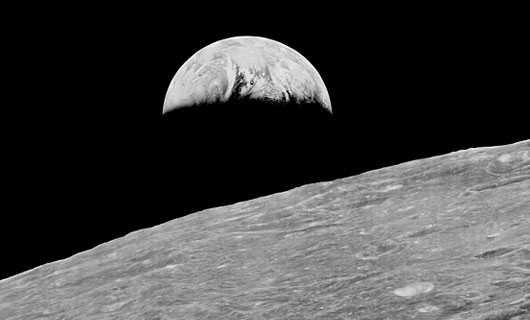
The Earth As Seen From The Moon by LRO

View larger image

The Earth as seen from the Moon! LROC NAC mosaic of images snapped on 12 June 2010 during a calibration sequence (Images E130954785L and E130954785R). Credit: NASA/Goddard/Arizona State University

Editor's note: According to Mark Robinson at ASU "The full res version has a pixel scale of 3.7 km. The lead in web posting has a pixel scale of 12.4 km. If you follow the link you can get to the full resolution mosaic on the LROC webpage. Since this is an orthographic view the pixel scale is calculated at the center of the disc, the resolution falls off as a cosine function towards the limb." Zoom in on the image here.

All cameras are susceptible to scattered light. You may have seen scattered light in pictures you have taken looking towards the Sun. Sunlight reflects off the optics and sometimes off the structure of the lens, and often appears as a gradient of brightness across the image. Attaching a baffle to your camera, like we did with the LROC Wide and Narrow Angle Cameras, can minimize this effect. More subtle effects are often present but usually you simply just don't notice artifacts because of strong color contrasts in the scene. Since the Moon has only very small color contrasts, the LROC team must characterize even subtle scattered light effects within the 7-color Wide Angle Camera (WAC) images. Changes in composition (rock types) result in subtle differences of color, typically about 10% or less. For scientists to make accurate interpretations of WAC color maps, the amount of scattered light must be quantified (and preferably corrected). One way of measuring scattered light is imaging a bright object against a dark background. From the Moon, the Earth serves that function well. While a series of WAC calibration images of the Earth were being acquired, the Narrow Angle Camera (NAC) was shuttered to capture this spectacular Earth view. The bottom of the Earth was clipped because the prediction of the exact time when the cameras' fields of view would cross the Earth was off by a few seconds.

Since the NAC acquires only one line of a picture at a time, the spacecraft had to be nodded across the Earth to build up the scene. The NAC Earth view is actually a mosaic of NAC-Left and NAC-Right images put together after calibration. The distance between the Moon and the Earth was 372,335 km when the picture was taken, with a pixel scale of about 3.7 km, and the center of this view of Earth is 25°N latitude, 114°E longitude (a few hundred kilometers north of Hong Kong).

View larger image

AP: Arabian Peninsula; CS: Caspian Sea; H: Himalayan Mountains; L: Lena River; I: Indian Ocean; A: Australia; J: Japan; P: Pacific Ocean; large yellow arrow indicates approximate position of the North Pole. Credit: NASA/Goddard/Arizona State University

It was a beautiful clear summer day over the North Pole. You can see ice covering most of the Arctic Ocean with a few leads of open water (dark) starting to open up. If you look very close you can follow the Lena River upstream from the Arctic Ocean all the way to Lake Baikal. Much of the Middle East was clear and you can trace spectacular swirl patterns of folded rock layers through Iran, Afghanistan, and Pakistan. These mountains formed as the Eurasian and Arabian tectonic plates collided.

Browse the full-sized image at the LRO Camera website maintained by Arizona State University.

March 11, 2010

Dumpster Diving for Science

NASA Dives Into Its Past to Retrieve Vintage Satellite Data, Science (subscription)

"Last month, researchers working out of an abandoned McDonald's restaurant on the grounds of NASA Ames Research Center recovered data collected by NASA's Nimbus II satellite on 23 September 1966. The satellite soared over Earth in a polar orbit every 108 minutes, taking pictures of cloud cover and measuring heat radiated from the planet's surface, and creating a photo mosaic of the globe 43 years ago. The resulting image is the oldest and most detailed from NASA's Earth-observing satellites. It's also the latest success story in what researchers call techno-archaeology: pulling data from archaic storage systems. Once forgotten and largely unreadable with modern equipment, old data tapes are providing researchers with new information on changes in the surfaces of Earth and the moon..."

... The LOIRP team obtained $750,000 from NASA and private enterprise and enlisted the assistance of a retired Ampex engineer. They cleaned, rebuilt, and reassembled one drive, then designed and built equipment to convert the analog signals into an exact 16-bit digital copy. "It was like dumpster diving for science," says Cowing, co-team leader at LOIRP. In November 2008, the team recovered their first image: a famous picture of an earthrise taken by Lunar Orbiter 1 on 23 August 1966. The team's new high-resolution version was so crisp and clear that it revealed many previously obscured details, such as a fog bank lying along the coast of Chile. "We thought if the Earth's surface looks that good a quarter of a million miles away, what does the moon's surface look like 100 miles beneath it?" says Cowing."

Click on image to enlarge

March 10, 2010

Nimbus II and Lunar Orbiter 1 Imagery: A New Look at Earth in 1966

On 23 August 1966, the Lunar Orbiter 1 spacecraft took a photo of the Earth as seen from lunar orbit. This image, albeit grainy, quickly became an icon of the Space Age. This "earthrise" photo, while spectacular at the time, was never retrieved and processed to the full level of detail contained in the image. This was due in great part of the available technology at the time. Computer image processing was in its infancy.

Forty two years later, the Lunar Orbiter Image Recovery Project (LOIRP) managed to retrieve the image from original data tapes using restored tape drives from the 1960s. In so doing the level of detail present in the image was unparalleled. Subsequently, other images have been retrieved with the ultimate goal of obtaining all of the images returned by the five Lunar Orbiters.

One of the striking aspects of this newly enhanced image is the amount of detail that can be seen on Earth at a resolution of perhaps 1 km/pixel taken from a quarter of a million miles away. Among the details visible is the extent of the southern polar ice cap.

The LOIRP required a lot of what has come to be called "techoarchaeology" that is, going back in time to the original data and recording devices, using modern enhancements. The expertise gained by the LOIRP team eventually caught the attention of the folks at the National Snow and Ice Data Center (NSIDC).

Data from the Nimbus weather and earth observation satellite - in orbit at the same time as the Lunar Orbiters were circling the Moon - had languished for years in the national archives until John Moses NASA Goddard Space Flight Center had them digitized.  

Dr. Walt Meir of the National Snow and Ice Data Center, after seeing the work that the LOIRP team had done in potentially identifying the Antarctic sea ice in the Lunar Orbiter 1 Earthrise image, and recognizing the similarity between the raw data of the Nimbus and Lunar Orbiter data, provided a grant to the LOIRP team to process the Nimbus data into a modern format and to correct image artifacts that are common to both types of images.  

The LOIRP team accomplished this, and rendered the images into the Google Earth format using a variety of internally developed techniques and elements of the NASA Ames developed NASA World Wind Java software development kit.

To date some of the images taken by Nimbus II have been enhanced and mapped into Google Earth. One date in particular was of interest to the LOIRP - 23 August 1966. As the images were enhanced and dropped into Google Earth it became clear that we have imagery that overlapped in time to show the weather on that late August day as evening crept up on Africa and Europe.

In New York City, just over the Earth's limb as seen from lunar orbit, the Beatles were preparing to play at Shea Stadium ...

You can download a KMZ file of these images here for viewing in Google Earth.

Related Links

- Techno-Archaeology Rescues Climate Data from Early Satellites
- LOIRP Aids In Finding Google Earth Images from 1966
- Newly Restored Lunar Orbiter Image of Earth and Moon (Detail)

The original Lunar Orbiter 1 image of Earth on 23 August 1966 (click on image to enlarge)

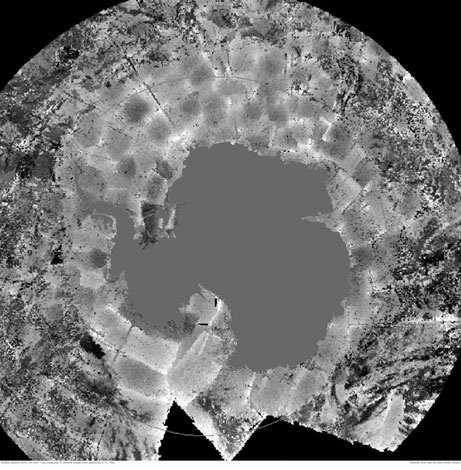
Nimbus II imagery of Earth on 23 August 1966 (click on image to enlarge)

Overlap of Nimbus II imagery onto Lunar Orbiter 1 imagery (click on image to enlarge)

February 5, 2010

National Snow and Ice Data Center on LOIRP

Techno-Archaeology Rescues Climate Data from Early Satellites, National Snow and Ice Data Center

Image: Forty-three years after the Nimbus II satellite collected these data, a team from NSIDC and NASA recovered a global image from September 23, 1966. In this view over Antarctica, overlaid on Google Earth, the Ross Ice Shelf appears clearly at left.

"Starting with the methods developed for the Lunar Orbiter Image Recovery Project (LOIRP) at NASA Ames Research Park, a team at NSIDC worked with Dennis Wingo at LOIRP to search NASA archives for the original Nimbus tapes containing raw images and calibrations. Their first goal was to read and reprocess the data at a higher resolution, removing errors resulting from the limits of the original processing."

February 4, 2010

LOIRP Aids In Finding Google Earth Images from 1966

Technoarcheology and Earth Sciences, the Recovery of Nimbus II High Resolution Infrared Radiometer Data

"In 2008 the Lunar Orbiter Image Recovery Project (LOIRP) began a NASA ESMD sponsored project to resurrect 43+ year old Ampex FR-900 instrumentation tape drives for the purpose of recovering, before the capability to do so becomes impossible, the last surviving master tapes from the five Lunar Orbiter spaceraft that orbited the Moon in support of Apollo in 1966-67. Our project is proceeding on our task to do so. During our research on the Ampex tape drives we scoured the NASA Technical Reports Server as well as any other source we could get our hands on. During this search, we found, through a Cadillac (yes the car) user group, a gentleman from Alaska who had worked on these drives during the 1960's. We were able to connect and while he had retired and the units were long gone to that great scrap yard in the sky, he told me something interesting. He said that during his time working on the drives that they had sent "miles and miles, thousands of tapes" to NASA during the Nimbus weather satellite program. This is where our new tale begins."

"One of the things that the LOIRP team is going to do is to take the Nimbus II HRIR data from August 23rd 1966 and overlay that with the Lunar Orbiter 1 data on the same date for a composite mosaic. There is potential for a significant synergy between Lunar Orbiter, Apollo, and Nimbus II and III data sets. This type of synergy could provide many benefits to the Earth sciences community."

May 29, 2009

House of Representatives Honors Lunar Orbiter Image Recovery Project

HONORING THE LUNAR ORBITER IMAGE RECOVERY PROJECT
HON. ZOE LOFGREN
OF CALIFORNIA
IN THE HOUSE OF REPRESENTATIVES

Monday, April 27, 2009

Ms. ZOE LOFGREN of California. Madam Speaker, I rise to commend the Lunar Orbiter Image Recovery Project and all those who have contributed their time and effort to ensure that historic images and vital data from the Lunar Orbiter missions of the 1960s are not lost to future generations.

In 1965, Charles Byrne, an engineer with Bellcomm, Inc., had the foresight to propose that NASA record data from the Lunar Orbiter missions onto tape recorders. NASA agreed and the images returned from the Lunar Orbiters were backed up on AMPEX FR-900 tape drives. To date, these images are some of highest resolution images we have of the Moon. Those images include a high-resolution version of “Earthrise,” the first picture of the Earth from the Moon’s vantage point. Time Magazine has called this image “the photo of the century.” The tapes also contain the first stereo imagery of the Moon’s surface. Indeed, these are some of the best images of the Moon ever taken, far superior from those received from the Hubble telescope.

Continue reading "House of Representatives Honors Lunar Orbiter Image Recovery Project" »

April 12, 2009

KTVU: Old NASA Tapes Reveal Stunning New Moon Images; Resolution Unparalleled

Old NASA Tapes Reveal Stunning New Moon Images; Resolution Unparalleled

KTVU looked at several images, and the detail and clarity are astonishing. It's the difference between grainy 35mm film with several generations of degradation, and the 70mm film original.

"Dennis Wingo brought up NASA's publicly released photo from August 23, 1966, called "Earthrise." Time Magazine called it the "Photo of the Century" and it is certainly amazing even today. But on the next screen Wingo showed the digitized version from the original tracking station tapes. Zooming in on the first version, Earth looks a bit fuzzy, though you can make out cloud patterns. On the recovered version, you can see fog along the Chilean coast, ice floes near the Antarctic. It is truly astonishing.

"Using these and some other 1966 images, we may be able to help push NASA's climate data back in time a full decade, which will help with climate change studies," says Wingo.

On shots of the lunar surface, the first versions show a blurry shadow here, some grayish along the horizon. The digitized recovered image is crisp with the deep black of space hovering over a multi-shaded gray surface, almost as if you were looking out the window of some lunar highrise. You can see rocks the size of an office chair. Sharp shadows and almost a 3D effect."

Full story and Video at KTVU

November 21, 2008

NASA Earth Observatory Features Recovered Lunar Orbiter Image

Earthrise 1966, NASA Earth Observatory

"Long before man journeyed to the moon and looked back at the tiny, fragile planet that houses humanity, remote orbiters were sending back pictures of home. Sent to scope out potential landing sites on the Moon, the series of five Lunar Orbiters also sent back the earliest views of Earth from another celestial body. This image, taken in 1966 by Lunar Orbiter 1, is among the first views of Earth from the Moon. In the black-and-white image, a crescent Earth floats majestically behind the lumpy surface of the Moon. Though clouds swirl across the atmosphere, hiding nearly all identifying features on the surface beneath, the western edge of Africa is faintly visible in the upper left. The Earth's North Pole points toward the top of the image."

November 16, 2008

Restored Lunar Orbiter Images Make it to Gizmodo

NASA Scales Up 1966's Moon Image to Amazing Ultra-High Resolution, Gizmodo

"When NASA released this image from their Lunar Orbiter 1 back in 1966, the first photograph ever of the Earth rising above the Moon's surface, it was low resolution but they still amazed the world. This week, they have surprised every space aficionado re-releasing the same image in ultra-high definition. The cool part now is that NASA hasn't used any upscaling or magical infinite zoom-in filter from CSI. Instead, they have created a new technology that uses refurbished analog machines and a new digital process that fully extracts the information stored in the program's old magnetic tapes, something that was impossible to do in the 60s. Click on the image to watch it in its 3673 x 1740 pixel glory."

November 13, 2008

Newly Restored Lunar Orbiter Image of Earth and Moon (Detail)

Portion of newly restored Lunar Orbiter 1 image. Originally taken on 23 August 1966 and restored by the Lunar Orbiter Image Recovery Project at NASA Ames Research Center. Larger image. Credit: NASA/LOIRP

How the Photo Was Taken

This chart from the 1960's shows the context of the newly restored Lunar Orbiter 1 image. This image was taken on 23 August 1966 and restored by the Lunar Orbiter Image Recovery Project at NASA Ames Research Center. The orientation of Earth was slightly off and shows a terminator about an hour off from what is actually in the image.Larger image. Credit: NASA/LOIRP


This graphic shows the actual orientation of Earth at the time the photo was taken. It was possible to match the outlines of north Africa in the newly restored image. Larger image. Credit: NASA/LOIRP

Seeing Clouds Shadows On Earth

This graphic compares the enhanced resolution of the LOIRP image and the highest resolution image available online at LPI. AT full resolution shadows can be seem between clouds and the Earth's surface at a resolution estimated to be around 1 kilometer per pixel. This image was taken on 23 August 1966 and restored by the Lunar Orbiter Image Recovery Project at NASA Ames Research Center. Larger image. Credit: NASA/LOIRP

November 10, 2008

NASA Unveils 42-Year-old Historic Lunar Image

MOFFETT FIELD, Calif. - NASA will hold a media briefing at 3 p.m. PST on Thursday, Nov. 13, 2008, to unveil a newly restored historic image from the early days of lunar exploration and discuss the innovative processing technique used to retrieve the image.

The briefing will take place in the Ames Research Center auditorium, Bldg. N-201. NASA officials will be available to discuss the recovery process and the scientific value of the iconic images to the next generation of explorers as NASA plans to return to the moon. A tour of the restoration facility will be offered following the briefing.

Briefing participants are:

- S. Pete Worden, Ames Research Center Director
- Greg Schmidt, Deputy Director, NASA Lunar Science Institute, NASA Ames
- Dennis Wingo, Image Recovery Project Lead, Huntsville, Ala.
- Charles J. Byrne, Lunar Image Expert, Middletown, N.J.

For news media representatives unable to attend, a roundtable discussion will be held following the briefing. Reporters wanting to participate must call Mike Mewhinney at 650-604-3937 by Wednesday, Nov. 12, 2008.

Driving Directions: To reach NASA Ames, take the Moffett Field/NASA Parkway exit off U.S. 101 and drive east on Moffett Boulevard towards the main gate. At the main gate, pull into the small parking lot on your right and enter the Visitor Badge Office to obtain a visitor pass. The auditorium is located directly behind the administration building as you enter the center.

For more information about NASA Ames Research Center, visit:

http://www.nasa.gov/ames

October 13, 2008

Man's First Look at Earth From the Moon....

NASA SP-168 EXPLORING SPACE WITH A CAMERA

ORBITER I

Describing the spectacular, historic view above, FLOYD L. THOMPSON, then Director, Langley Research Center, wrote: "At 16:35 GMT on August 23, 1966, the versatile manmade Lunar Orbiter spacecraft responded to a series of commands sent to it from Earth, across a quarter-million miles of space, and made this over-the-shoulder view of its home planet from a vantage point 730 miles above the far side of the Moon.

"At that moment," Thompson continued, "the Sun was setting along an arc extending from England [on the right] to Antarctica [on the left]. Above that line, the world, with the east coast of the United States at the top, was still bathed in afternoon sunlight. Below, the major portion of the African Continent and the Indian Ocean were shrouded in the darkness of evening. "By this reversal of viewpoint, we here on the...

... and an Oblique View of the Moon Itself

....Earth have been provided a sobering glimpse of the spectacle of our own planet as it will be seen by a few of our generation in their pursuit of the manned exploration of space. We have achieved the ability to contemplate ourselves from afar and thus, in a measure, accomplish the wish expressed by Robert Burns: 'To see oursels as ithers see us! "

Also visible in dramatic new perspective in this photograph is the singularly bleak Iunar landscape, its tortured features evidently hammered out by a cosmic bombardment that may have extended over billions of years.

Because the airless, weatherless Moon appears to preserve its surface materials so well, it may serve science as an illuminating record of past events in the solar system. ROBERT JASTROW, Director Goddard Institute for Space Studies, has called the Moon "the Rosetta Stone of the planets."

Space News
- Moontoday.net
- OnOrbit.com
- SpaceRef.com
- ColabSpace

About Earth Imagery

This page contains an archive of all entries posted to MoonViews - Providing Imagery and Data For Lunar Exploration in the Earth Imagery category. They are listed from oldest to newest.

Books is the previous category.

Education & Outreach is the next category.

Many more can be found on the main index page or by looking through the archives.

PARTICIPANTS
- NASA ESMD
- NASA IPP
- NASA ARC
- NASA LSI
- ACES
- SpaceRef Interactive
- SkyCorp
- Odyssey Moon
- USGS
- LPI
- PDS

LUNAR ORBITER
- Overview
- Images
- Documents

LUNAR MISSIONS
Scientific
- Apollo
- Chandrayaan-1
- Chang'e-1
- Clementine
- Kaguya
- Lunar Reconnaissance Orbiter
- LCROSS
- Luna
- Lunakhod
- Lunar Prospector
- Ranger
- SMART-1
- Surveyor
- Zond

Commercial
- Google Lunar X Prize


Copyright 2008
MoonViews LLC